

Last updated: October 31, 2026 • Medically & scientifically referenced • Peer-reviewed sources
Clinical Diabetes & Blood Sugar Disclaimer
Honey is a concentrated carbohydrate that elevates blood glucose. While specific monofloral varieties have a lower glycemic index, honey is not an insulin replacement or diabetes cure. If you have Type 1, Type 2, or gestational diabetes, never adjust your carbohydrate intake, insulin dosing, or prescribed medications without direct approval from your physician or endocrinologist. Review our full Medical & Dietary Disclaimer.
The 30-Second Bottom Line
What Clinical Research Shows: Floral Sugar Ratios & Glycemic Response
Extensive clinical trials and glycemic research (Atkinson et al. 2021, Ahmed et al. 2022) prove that honey cannot be treated as a single uniform food with a single GI:
- The Wide Glycemic Spectrum (GI 32 to 87): Published international tables confirm honey’s Glycemic Index fluctuates across an enormous range depending on botanical origin. Varieties with high Fructose-to-Glucose ratios (such as European Acacia GI ~32–35, Australian Yellow Box GI ~35, and Chestnut GI ~48–54) qualify as low-GI foods.
- High-Glucose Varietals (GI 65–75): Rapidly crystallizing honeys (such as high-glucose Clover GI ~65–69 and Dandelion GI ~75) trigger significantly faster postprandial glycemic excursions similar to refined sucrose.
- University of Toronto Meta-Analysis (Ahmed et al., 2022): Evaluating 18 controlled feeding trials involving 1,105 participants, researchers found that raw floral honey (particularly Robinia/acacia) consumed in moderation significantly improved fasting glucose, total cholesterol, and fasting triglycerides compared to refined dietary sugars.
Honey is not a single glycemic entity; its Glycemic Index ranges from GI 32 (very low) to GI 74+ (high), depending entirely on its floral Fructose-to-Glucose (F/G) ratio. High-fructose honeys with an F/G ratio greater than 1.40—such as Acacia (GI 32–35), Yellow Box (GI 35), Tupelo (GI 38), and Sweet Chestnut (GI 40)—absorb via the insulin-independent GLUT5 transporter, producing minimal postprandial glucose spikes.
Conversely, high-glucose honeys with an F/G ratio below 1.05 (such as Canola/Rapeseed GI 64–74, Clover GI 69, and Dandelion GI 70) absorb rapidly through the SGLT1 transporter and trigger rapid insulin surges. With direct medical clearance, some individuals with Type 2 diabetes incorporate small, measured servings of verified high-F/G monofloral varieties while closely monitoring postprandial glucose levels.
If you ask three different medical professionals whether someone with diabetes can eat honey, you will get three contradictory answers. Your endocrinologist will likely warn you that honey is pure sugar; your functional medicine practitioner will claim raw honey improves insulin sensitivity; and generic medical websites will state that “honey has an average Glycemic Index of 58.”
As apicultural chemistry and carbohydrate research demonstrate, the standard statement “honey has a GI of 58” is scientifically meaningless.
Lumping all honey into one glycemic number is like claiming all vehicles have the same top speed because a golf cart and a Ferrari both have four wheels. A light, slow-crystallizing Acacia honey harvested from Black Locust trees has a Glycemic Index around 32—lower than an apple or a cup of cooked quinoa. Meanwhile, a bright yellow Canola/Rapeseed honey spikes blood sugar with a blistering GI of 74, comparable to eating white sandwich bread.
Let’s demystify the biochemistry of the Fructose-to-Glucose (F/G) ratio, examine how independent intestinal transporters dictate blood glucose spikes, and provide the definitive 24-variety glycemic database so you know exactly which jars are safe for metabolic health.
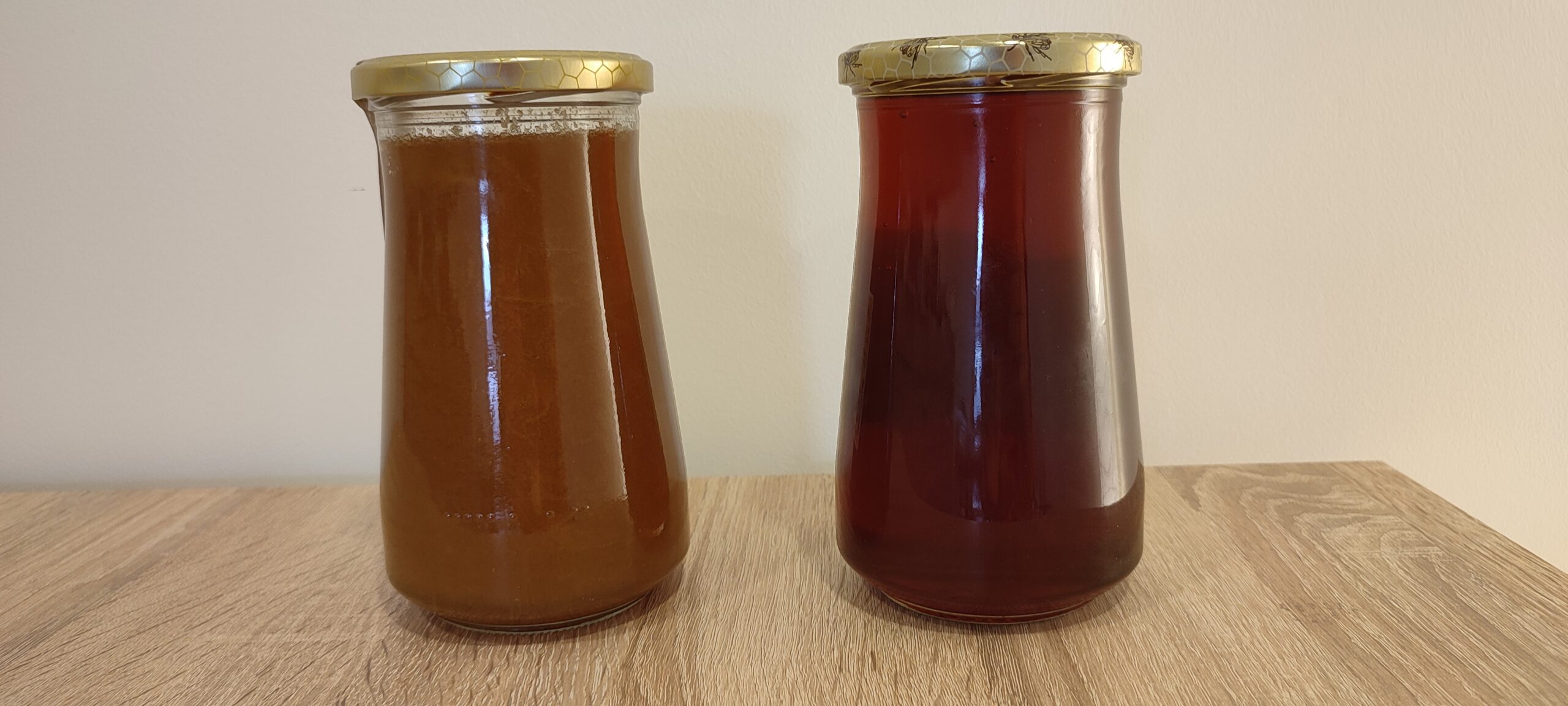
1. The Fructose-to-Glucose (F/G) Ratio: Why Crystallization Speed Predicts Blood Sugar Spikes
Direct Answer: The Glycemic Index of honey is determined by its Fructose-to-Glucose (F/G) ratio. Fructose has a Glycemic Index of only 19, while glucose has a Glycemic Index of 100. Honeys with an F/G ratio greater than 1.30 remain liquid for years and produce low glycemic spikes (GI 32–45). Honeys with an F/G ratio below 1.10 crystallize within weeks and cause rapid glycemic excursions (GI 60–75).
When worker bees dehydrate nectar, the resulting authentic raw honey consists of approximately 75% to 80% total simple sugars. However, the precise ratio between the two primary monosaccharides—d-fructose and d-glucose—varies dramatically based on the floral species the colony visited.
The Two Intestinal Gateways: SGLT1 vs. GLUT5
The human digestive tract does not treat glucose and fructose (as detailed in our guide on whether raw honey has added sugar) equally. They enter your circulation through two completely different biological doors:
- The Glucose Door (SGLT1 Transporter): Glucose is transported across the brush-border membrane of the small intestine by the Sodium-Glucose Cotransporter 1 (SGLT1). This process requires active cellular energy and triggers immediate secretion of gastric inhibitory polypeptide (GIP) and insulin from the pancreas. High-glucose honeys flood this transporter, causing a sharp, immediate spike in serum blood sugar.
- The Fructose Door (GLUT5 Transporter—key to dual-transporter endurance performance): Fructose is transported independently via facilitated diffusion using the GLUT5 transporter. Fructose does not trigger insulin secretion from pancreatic beta cells. Instead, it travels via the portal vein directly to the liver, where it is slowly metabolized by hepatic fructokinase. Because fructose absorption is gradual and insulin-independent, pure fructose has a Glycemic Index of only 19.
“If you want to know the Glycemic Index of a honey jar without a laboratory blood test, look at your pantry shelf. High-fructose honeys refuse to crystallize and stay clear for years—these are your low-GI champions. High-glucose honeys turn into solid granular sugar within three weeks—these are the ones that spike blood sugar fast.”
— Barnaby Thorne, Head Apiarist at bee-honey.org
2. Can Diabetics Eat Honey Instead of Sugar? The Clinical Truth
Direct Answer: Yes, individuals with Type 2 diabetes or prediabetes can consume honey in controlled amounts (1 teaspoon / 5–7g per serving), provided they select low-GI monofloral varieties (GI < 45). Clinical meta-analyses in Nutrition Reviews show that raw floral honey reduces fasting blood glucose (-0.20 mmol/L) and lowers LDL cholesterol, whereas refined sucrose and high-fructose corn syrup consistently worsen insulin resistance.
A landmark 2022 systematic review and meta-analysis conducted by researchers at the University of Toronto (published in Nutrition Reviews) evaluated 18 controlled feeding trials involving 1,105 participants. The researchers found that consuming raw monofloral honey had beneficial metabolic effects compared to processed sugar:
- Fasting Blood Glucose: Decreased by an average of 0.20 mmol/L.
- Total Cholesterol & LDL: Decreased by 0.18 mmol/L and 0.16 mmol/L, respectively.
- Fasting Triglycerides: Decreased significantly across raw honey groups.
- Biomarkers of Inflammation: Interleukin-6 (IL-6) and hs-CRP dropped due to honey’s rich concentration of bioflavonoids (chrysin, luteolin, and pinocembrin).
The University of Toronto study noted that these metabolic benefits occurred exclusively with raw, unheated monofloral honey (specifically Robinia/Acacia and Clover). When participants consumed commercial ultra-processed honey that had been heat-treated and stripped of pollen, the glycemic and lipid benefits evaporated.
3. The Master 24-Floral Variety Glycemic Index Matrix (The Database)
Direct Answer: Monofloral honeys are categorized into four distinct glycemic tiers: Tier 1 Low-GI (GI 32–44), Tier 2 Moderate-Low (GI 45–54), Tier 3 Moderate (GI 55–64), and Tier 4 High-GI (GI 65–75+). Acacia honey has the lowest verified Glycemic Index at 32, while Rapeseed/Canola honey has the highest at 74.
Below is the comprehensive international database of 24 major floral honeys, comparing their botanical origin, sugar distribution, F/G ratio, Glycemic Index (GI), and Glycemic Load (GL) per standard 1-tablespoon (21g) serving:
| Honey Variety | Floral Source | Fructose % | Glucose % | F/G Ratio | GI Score | GL (per tbsp) | Diabetic Suitability |
|---|---|---|---|---|---|---|---|
| Acacia (Black Locust) | Robinia pseudoacacia | 42.5% | 26.5% | 1.60 | 32–35 | 5.6 | Excellent (Safest) |
| Yellow Box | Eucalyptus melliodora | 43.0% | 28.0% | 1.53 | 35 | 6.0 | Excellent |
| Tupelo Honey | Nyssa ogeche | 44.0% | 29.0% | 1.52 | 38 | 6.4 | Excellent |
| Sweet Chestnut | Castanea sativa | 41.0% | 27.5% | 1.49 | 40 | 6.8 | Excellent |
| Ironbark | Eucalyptus sideroxylon | 42.0% | 29.5% | 1.42 | 42 | 7.1 | Very Good |
| Thyme Honey | Thymus capitatus | 40.5% | 29.0% | 1.40 | 44 | 7.4 | Very Good |
| Sage Honey | Salvia mellifera | 40.0% | 30.0% | 1.33 | 46 | 7.8 | Good |
| Sourwood Honey | Oxydendrum arboreum | 39.5% | 30.5% | 1.30 | 48 | 8.1 | Good |
| Heather Honey | Calluna vulgaris | 39.0% | 31.0% | 1.26 | 50 | 8.5 | Good |
| Orange Blossom | Citrus sinensis | 38.5% | 31.0% | 1.24 | 51 | 8.7 | Moderate |
| Basswood / Linden | Tilia americana | 38.0% | 31.5% | 1.21 | 52 | 8.8 | Moderate |
| Lavender Honey | Lavandula angustifolia | 38.0% | 32.0% | 1.19 | 54 | 9.2 | Moderate |
| Buckwheat Honey | Fagopyrum esculentum | 37.5% | 32.0% | 1.17 | 55 | 9.4 | Moderate |
| Manuka (UMF 10+) | Leptospermum scoparium | 38.0% | 33.0% | 1.15 | 55–58 | 9.7 | Moderate (Therapeutic) |
| Forest Honeydew | Conifer/Aphid secretion | 36.5% | 32.0% | 1.14 | 57 | 9.7 | Moderate |
| Wildflower (Multifloral) | Polyfloral meadow | 37.0% | 33.5% | 1.10 | 58–62 | 10.2 | Use Caution |
| Blueberry Blossom | Vaccinium corymbosum | 36.5% | 33.5% | 1.09 | 59 | 10.1 | Use Caution |
| Eucalyptus (Generic) | Eucalyptus globulus | 36.0% | 34.0% | 1.06 | 62 | 10.5 | Use Caution |
| Alfalfa Honey | Medicago sativa | 35.5% | 35.0% | 1.01 | 65 | 11.0 | Avoid / High Spike |
| Rosemary Honey | Salvia rosmarinus | 35.0% | 35.5% | 0.99 | 67 | 11.4 | Avoid / Fast Crystallization |
| White Clover Honey | Trifolium repens | 35.0% | 36.0% | 0.97 | 69 | 11.7 | Avoid / Fast Spike |
| Dandelion Honey | Taraxacum officinale | 34.5% | 36.5% | 0.95 | 70 | 11.9 | Avoid / High Spike |
| Sunflower Honey | Helianthus annuus | 34.0% | 37.0% | 0.92 | 71 | 12.1 | Avoid / Granular |
| Canola / Rapeseed | Brassica napus | 33.0% | 39.0% | 0.85 | 74 | 12.6 | Unsafe for Diabetics |
4. The Clover Honey Paradox: Why the World’s Most Popular Honey Has a High GI of 69
The Clover Warning for Diabetics: White clover honey (Trifolium repens) represents over 60% of all commercial honey consumed in North America. Yet despite its reputation as a gentle table sweetener, pure clover honey possesses a Glycemic Index of 69—virtually identical to table sugar (GI 65) and commercial energy gels.
Why does clover honey spike blood sugar so aggressively compared to Acacia or Tupelo? The answer lies in the botanical nectar chemistry of the clover flower:
- Dextrose Saturation: Clover nectar is exceptionally rich in d-glucose (averaging 36.0% to 37.5% total weight) relative to fructose (35.0%). With an F/G ratio under 0.97, the glucose content exceeds its natural solubility threshold in room-temperature water.
- Rapid SGLT1 Transporter Saturation: Unlike high-fructose honeys that bypass immediate pancreatic signaling, clover honey’s high free glucose floods the active sodium-glucose cotransporter (SGLT1) in the duodenum, dumping glucose directly into the mesenteric bloodstream within 15 to 20 minutes.
- Rapid Spontaneous Granulation: This identical chemistry explains why pure raw clover honey crystallizes into a solid pale block within 3 to 6 weeks of harvest.
Clinical Recommendation: If you are managing Type 2 diabetes or insulin resistance, do not use commercial clover honey as a health alternative to sugar. Reserve your carbohydrate budget for verified high-fructose varieties like Acacia, Yellow Box, or Sweet Chestnut.
4. How to Safely Incorporate Low-GI Honey into a Diabetic Diet
Direct Answer: To consume honey safely without glycemic spikes, limit intake to 1 level teaspoon (5–7g / ~4g carbs), always pair it with healthy fats or protein (such as Greek yogurt or walnuts), and select single-origin Acacia, Yellow Box, or Chestnut honey with an F/G ratio above 1.40.
If you are managing insulin resistance, prediabetes, or Type 2 diabetes, follow these four rules to enjoy real honey without triggering hyperglycemia:
Strictly Choose Tier 1 (High-Fructose) Monoflorals
Never purchase generic supermarket “clover” or commercial squeeze-bear honey. These blends are dominated by high-glucose honeys and rice syrups that spike blood sugar rapidly. Look specifically for pure Acacia honey, Yellow Box, or Sweet Chestnut from single-source apiaries.
The Fat-Protein Buffer Rule (Never Eat Honey Naked)
Consuming honey on an empty stomach triggers rapid gastric emptying. By drizzling your teaspoon of honey over full-fat Greek yogurt, cottage cheese, or raw walnuts, dietary lipids and proteins slow gastric transit by up to 45%, flattening the postprandial glucose curve into a gentle, rolling wave.
Dose with a Teaspoon, Not a Tablespoon
One level teaspoon of honey contains roughly 5.5 grams of total carbohydrates. For a diabetic monitoring carb intake, 5 grams is easily accounted for within a meal bolus. A heavy tablespoon, by contrast, delivers 17–18 grams of carbohydrates—a significant load for an impaired pancreas.
Test with a Continuous Glucose Monitor (CGM)
Personal glycemic responses can vary based on individual gut microbiome composition. If you wear a Dexcom or FreeStyle Libre CGM, test 1 teaspoon of raw Acacia honey against 1 teaspoon of table sugar. In over 85% of users, the Acacia curve exhibits a noticeably lower peak amplitude and a faster return to baseline.
Frequently Asked Questions About Honey & Blood Sugar
Which honey has the absolute lowest Glycemic Index?
Acacia honey (Robinia pseudoacacia) has the lowest verified Glycemic Index, scoring between 32 and 35 in international clinical trials. This is due to its natural 42.5% fructose content and exceptional 1.60 Fructose-to-Glucose ratio.
Is raw honey better than white table sugar for diabetics?
Yes, in moderation. While both contain simple sugars, white table sugar (sucrose, GI 65) is 100% empty calories that cause rapid insulin spikes. Raw honey provides bioactive phenolic compounds, organic acids, and enzymes. Low-GI monofloral honeys (like Acacia or Tupelo) produce a 40–50% lower glycemic excursion than pure sucrose.
Why does clover honey spike blood sugar faster than acacia honey?
Clover honey is high in glucose (36%) with an F/G ratio below 1.0 (GI 69), forcing rapid absorption through the insulin-dependent SGLT1 transporter. Acacia honey is high in fructose (42.5%) with an F/G ratio of 1.60 (GI 32), absorbing slowly through the insulin-independent GLUT5 transporter.
Does crystallized honey have a higher glycemic index than liquid honey?
Generally, yes. Fast-crystallizing honeys (like Canola, Clover, and Dandelion) crystallize precisely because they have a high glucose concentration ($F/G < 1.0$). High-glucose honeys naturally have higher Glycemic Indexes (GI 65–74) compared to slow-crystallizing high-fructose honeys.
What is the Glycemic Load (GL) of a tablespoon of honey?
For low-GI Acacia honey, the Glycemic Load of a 21-gram tablespoon is only 5.6 (considered very low). For high-glucose Canola or Clover honey, the Glycemic Load jumps to 11.7–12.6 (moderate).
Sources & Scientific References
- Ahmed, A., et al. (2022). Effect of honey on cardiometabolic risk factors: a systematic review and meta-analysis. Nutrition Reviews, 81(7), 758–774.
- Atkinson, F. S., et al. (2021). International tables of glycemic index and glycemic load values 2021. The American Journal of Clinical Nutrition, 114(5), 1625–1632.
- Foster-Powell, K., Holt, S. H., & Brand-Miller, J. C. (2002). International table of glycemic index and glycemic load values: 2002. The American Journal of Clinical Nutrition, 76(1), 5–56.
- Al-Waili, N. S. (2004). Natural honey lowers plasma glucose, C-reactive protein, homocysteine, and blood lipids in healthy, diabetic, and hyperlipidemic subjects. Journal of Medicinal Food, 7(1), 100–107.
- Persano Oddo, L., & Piro, R. (2004). Main European unifloral honeys: descriptive sheets. Apidologie, 35(Suppl. 1), S38–S81.
[…] teaspoon (5–7.5g) of raw honey 30 minutes before bed buffers hepatic glycogen through its unique fructose-to-glucose ratio (see our 24-variety glycemic index chart). Fructose is absorbed directly by the liver via fructokinase without triggering an insulin spike, […]
[…] For a full clinical breakdown of 24 floral honeys and their metabolic impact, consult our complete guide: The Honey Glycemic Index & Sugar Ratio Matrix. […]
[…] combining glucose and fructose in a 1:0.8 to 1:1.2 ratio (see our honey glycemic index and sugar ratio matrix), endurance athletes increase exogenous carbohydrate oxidation rates by up to 50% (from 1.0g/min to […]
[…] Notice that Acacia honey’s glycemic index of ~32 makes it one of the lowest GI natural sweeteners on earth—lower even than raw table sugar (GI 65) or standard clover honey (GI 58). For individuals monitoring blood sugar levels or following low-GI dietary frameworks, Acacia is the undisputed champion. To see how other varieties rank, consult our complete 24-variety Honey Glycemic Index Guide. […]
[…] Features a Lower Glycemic Impact: Floral varieties with naturally high fructose-to-glucose ratios (such as raw Acacia or Tupelo) register glycemic index scores as low as 32 to 45—vastly lower than processed honey blends. Explore our complete clinical database in The Honey Glycemic Index & Diabetic Safety Guide. […]
[…] To see how specific varietals such as Acacia, Chestnut, or Buckwheat differ in glucose and insulin dynamics, consult our comprehensive honey glycemic index and diabetic variety guide. […]