

The 30-Second Bottom Line
Authentic pure raw honey contains zero added sugar, zero cane syrup, and zero high-fructose corn syrup. However, raw honey is naturally composed of roughly 82% natural carbohydrates, dominated by the simple monosaccharides fructose (~38.2%) and glucose (~31.3%). Under U.S. FDA labelling rules established in 2019, single-ingredient honey containers display a percent Daily Value (%DV) under the “Added Sugars” line accompanied by a mandatory dagger symbol (†) clarifying that nothing has been physically added to the jar.
1. Natural Sugar Composition: Every tablespoon (21g) delivers 17g of naturally occurring sugars synthesized by honeybees from floral nectar via the salivary enzyme invertase.
2. The FDA Label Paradox: The FDA classifies honey carbohydrates under “Added Sugars” solely because honey is consumed as a dietary sweetener, not because processors spiked the jar.
3. Metabolic Advantage: Unlike refined white table sugar (50% bonded sucrose), raw honey provides unbound monosaccharides and bioactive oligosaccharides with a lower glycemic index (average GI 35–58 vs 68 for table sugar).
The Bottom-Line Warning: Commercial adulteration remains an international challenge. If a discount bottle lists “corn syrup,” “fructose syrup,” or fails isotopic carbon purity screening, it is not authentic raw honey. Always verify single-ingredient floral sourcing.
When you twist open a fresh jar of raw honey, you are looking at one of nature’s most concentrated carbohydrate matrices. Yet standing in the supermarket aisle, thousands of shoppers freeze when they flip over a pure wildflower jar and read the Nutrition Facts panel: “Includes 17g Added Sugars (34% DV) †.” How can a jar harvested straight from an apiary frame contain “added” sugar? Did the beekeeper dump table sugar into the extractor?
The answer lies at the intersection of federal food regulatory policy, bee biochemistry, and global carbohydrate economics. In this definitive guide, we break down the exact molecular composition of raw honey, unpack why federal regulators created the confusing “dagger footnote,” examine how honey sugars behave in human metabolism, and explain how laboratory spectroscopy detects illegal syrup adulteration.
What the Research Shows: The Carbohydrate & Purity Benchmark
Peer-reviewed chemical analysis across international food standards establishes the baseline carbohydrate composition of unadulterated floral honey:
- Standard Carbohydrate Profile (Doner 1977; White 1978, USDA): Unadulterated floral honey averages 38.2% D-fructose, 31.3% D-glucose, 1.3% sucrose, and 7.1% higher oligosaccharides (maltose, isomaltose, turanose, melezitose), with 17.2% water and 3.2% minerals and enzymes.
- Regulatory Definition (Codex Alimentarius CXS 12-1981): Standard Section 3.1 explicitly mandates: “Honey sold as such shall not have added to it any food ingredient, including food additives, nor shall any other additions be made other than honey.”
- Glycemic Clinical Trials (Deibert et al. 2010, Eur J Clin Nutr): Testing across healthy human cohorts demonstrated that honey varieties with elevated fructose-to-glucose ratios (such as Acacia) elicit significantly lower postprandial glucose and insulin responses compared to standard sucrose.
1. Does Raw Honey Have Sugar? The Bee Biochemistry Explained
Yes, raw honey is overwhelmingly composed of natural sugar. In fact, sugar makes up roughly 80% to 82% of raw honey by weight, with water accounting for 15% to 18%, and the remaining 2% to 3% consisting of enzymes, pollen proteins, organic acids, and trace minerals.
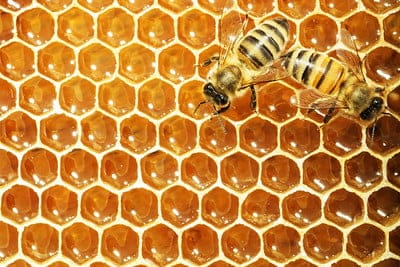
Honeybees (Apis mellifera) do not collect honey from flowers; they forage for liquid nectar, an aqueous plant secretion that is primarily composed of 80% water and 20% complex sucrose. The miraculous transformation occurs in the forager bee’s honey stomach (proventriculus). The bee secretes the digestive enzyme invertase (alpha-glucosidase), which hydrolyzes the chemical bond uniting glucose and fructose:
Once back at the hive, younger processor bees regurgitate and pass the droplet from bee to bee, further enzymatically reducing complex oligosaccharides. The bees deposit the thinned nectar into open wax cells and rapidly beat their wings at roughly 200 Hz. This ventilation generates hive airflow that evaporates the moisture from ~80% down to under 18.6%.
The result is a supersaturated carbohydrate solution. Because the sugars are fully unbonded monosaccharides, the body digests raw honey along distinct physiological pathways compared to crystalline table sugar. For a detailed breakdown of how raw honey differs from commercially pasteurized jars, explore our guide on raw honey vs regular processed honey differences.
2. Why Does Pure Honey Say “Added Sugars” on the Nutrition Label?
The “Added Sugars” line on pure honey (see our breakdown on pure honey vs raw honey) is a regulatory classification, not a sign of adulteration. When the U.S. Food and Drug Administration (FDA) revised the Nutrition Facts label under the 2016 regulations, it defined “Added Sugars” as sugars added during processing or packaged as a standalone sweetener intended to be added to foods.
Under the original draft of the rule, a 1-pound jar of 100% pure raw wildflower honey would have been legally required to declare “Includes 17g Added Sugars per serving.” Beekeepers and consumers across the United States rightfully erupted in protest. Listing “Added Sugars” on a pure single-ingredient product harvested directly from insects led consumers to believe beekeepers were covertly mixing high-fructose corn syrup or refined beet sugar into their honey.
The 2018 Farm Bill & 2019 FDA Final Guidance Solution:
Under Section 12516 of the 2018 Agriculture Improvement Act and the FDA’s June 2019 Final Guidance (Declaration of Added Sugars on Honey, Maple Syrup, and Other Single-Ingredient Sugars), single-ingredient honey:
• Is exempt from printing the numeric gram amount of Added Sugars on the label.
• Must display the percent Daily Value (%DV) (e.g., 34% DV per 21g serving).
• May include a clarifying dagger symbol (†) leading directly to a footnote stating: “One serving adds 17g of sugar to your diet and represents 34% of the Daily Value for Added Sugars.”
The percent Daily Value is required so that dietary planners, diabetics, and consumers can gauge how a tablespoon of honey contributes to the USDA recommended daily ceiling of 50 grams of discretionary sweetener. But make no mistake: on a single-ingredient jar, not a single grain of sugar was physically added.
3. Master Sugar Matrix: Raw Honey vs Table Sugar, HFCS & Natural Sweeteners
Not all sugars produce identical biological responses. The glycemic impact, enzymatic activity, and metabolic fate of carbohydrates depend heavily on whether sugars exist as disaccharide polymers or free monosaccharides.
| Sweetener | Primary Sugars | Fructose / Glucose Ratio | Glycemic Index (GI) | Enzymes & Bioactives | Dietary Verdict |
|---|---|---|---|---|---|
| Raw Floral Honey | Fructose (38%), Glucose (31%) | 1.10 – 1.55 (Floral dependent) | 35 – 58 (Low to Moderate) | Invertase, diastase, defensin-1, polyphenols | Superior Whole Food |
| Refined White Sugar | Sucrose (99.9% bonded) | 1.00 (Exact 50/50 bond) | 65 – 68 (High) | None (Stripped during refining) | Empty Calories |
| High Fructose Corn Syrup (HFCS-55) | Free Fructose (55%), Glucose (42%) | 1.31 | 58 – 65 (Moderate to High) | Zero bioactives; processed chemical | Avoid Adulterant |
| Pure Maple Syrup | Sucrose (66%), Water (33%) | 1.00 | 54 (Moderate) | Manganese, zinc, quebecol | Wholesome Mineral Alternative |
| Agave Nectar | Fructose (75%–85%), Glucose (15%) | 4.00 – 5.60 | 15 – 30 (Very Low) | Heated hydrolyzed saponins | Excess Liver Fructose Burden |
To see how specific varietals such as Acacia, Chestnut, or Buckwheat differ in glucose and insulin dynamics, consult our comprehensive honey glycemic index and diabetic variety guide.
4. How Your Body Processes Honey Sugars: The Dual-Transporter Advantage
Your digestive tract absorbs the sugars in raw honey via two parallel cellular transport systems. When you ingest table sugar, your intestinal brush border must first expend energy cleaving the sucrose molecule into glucose and fructose.
In raw honey, because the bee’s enzymes have already completed this hydrolysis, the sugars absorb simultaneously across the enterocyte membrane without metabolic lag:
- SGLT1 Transporter (Sodium-Glucose Linked Transporter 1): Handles the active, sodium-dependent uptake of glucose into the bloodstream, triggering moderate pancreatic insulin release and restocking muscle glycogen.
- GLUT5 Transporter (Glucose Transporter 5): Facilitates the passive absorption of fructose directly to the portal vein and liver, where it converts to hepatic glycogen without stimulating an acute insulin spike.
This physiological duality is why high-fructose raw honeys support sustained nocturnal glucose stability (preventing early morning cortisol spikes, as examined in our 3 AM cortisol awakening analysis) and provide superior sustained endurance fuel without the gastrointestinal distress caused by concentrated synthetic maltodextrin gels.
5. Real Added Sugar Adulteration: How Cheap Syrups Infiltrate Commercial Honey
While authentic raw honey contains no added sugar, economically motivated adulteration remains a serious issue in commercial supply chains. Unscrupulous honey exporters and large-scale packers have historically diluted honey with industrial sugar syrups to increase volume and lower costs.
Commercial adulteration falls into two primary chemical categories based on the photosynthetic pathway of the source plant:
Corn & Cane Syrups
Corn and sugarcane utilize Hatch-Slack (C4) photosynthesis, enriching their carbon isotope ratio (\(\delta^{13} ext{C}\)). The gold-standard test—EA-IRMS (Elemental Analysis-Isotope Ratio Mass Spectrometry)—compares whole honey \(\delta^{13} ext{C}\) against its extracted protein fraction. If the difference exceeds 7%, illegal C4 sugar addition is proven.
Rice, Beet & Wheat Syrups
Rice and sugar beets share the Calvin (C3) photosynthetic cycle with honey-producing flowers, evading traditional IRMS detection. Modern accreditation laboratories counter this using \(^1 ext{H}\)-NMR (Proton Nuclear Magnetic Resonance) spectroscopy profiling, which flags foreign polysaccharide markers and synthetic enzyme residues.
For a full investigative breakdown of laboratory isotope testing and why viral kitchen tests fail, read our forensic guide on testing honey purity: fake vs real lab science.
6. The Myth-Buster Vault: Honey Sugar Misconceptions
Myth: “Raw honey has no sugar because it is natural.”
The Scientific Reality: All honey is fundamentally sugar. One tablespoon (21 grams) delivers roughly 64 calories and 17 grams of concentrated carbohydrates. While it contains valuable polyphenols and enzymes, it still counts toward daily carbohydrate intake and must be managed carefully by individuals with insulin resistance or diabetes.
Myth: “If my honey crystallizes into hard white sugar, the beekeeper added white table sugar.”
The Scientific Reality: Crystallization is the single strongest physical hallmark of 100% authentic, unheated raw honey. Because honey is naturally supersaturated with glucose, excess glucose molecules naturally precipitate out of solution and latch onto microscopic pollen grains. Syrups spiked with high-fructose corn syrup actually resist crystallization indefinitely. Learn how to gently reliquefy your jar in our guide on why honey crystallizes and how to decrystallize safely.
Myth: “Diabetics can eat unlimited raw honey because the glycemic index is zero.”
The Scientific Reality: Honey does not have a zero glycemic index. While varietals like Black Locust (Acacia) have a low GI of ~35–40, high-glucose honeys (like clover or wildflower) range from 50 to 65. Honey will raise blood glucose and requires insulin coverage in Type 1 diabetes and carbohydrate counting in Type 2 diabetes.
7. The Kitchen Counter Label Audit: 4 Rules for Buying Pure Honey
When shopping for genuine raw honey that is completely free of industrial syrup adulteration, apply this practical 4-step checklist before purchasing:
- Check the Ingredient List: The ingredients list should state exactly one word: “Honey” (or “Raw Floral Honey”). If you see “Honey blend,” “Glucose-fructose syrup,” or “Natural honey flavoring,” put it back.
- Inspect the Added Sugars Footnote: Look for the dagger symbol (†) on the Nutrition Facts panel. Confirm that the footnote explicitly states that the sugars are naturally occurring single-ingredient sugars.
- Look for Varietal and Regional Sourcing: Authentic raw honey specifies a floral source (e.g., Orange Blossom, Buckwheat, Clover) and a designated geographical origin (e.g., Montana, New Zealand, Local State Apiary). Avoid vague labels reading “Blend of honey from multiple countries.”
- Look for Natural Opacity or Fine Granulation: Ultra-clear, ultra-runny honey sold in plastic bear squeeze bottles is almost always micro-filtered through diatomaceous earth and heated above 160°F (71°C), denaturing beneficial diastase enzymes. Pure raw honey has natural cloudiness, fine crystallization, or visible pollen flecks.
Medical & Dietary Disclaimer: This article is intended for educational and nutritional informational purposes only and does not constitute individual medical or dietary advice. While authentic raw honey has a lower glycemic response than refined sucrose, it contains significant natural carbohydrates and will elevate blood glucose levels. Individuals diagnosed with diabetes, insulin resistance, or metabolic conditions should consult their endocrinologist or certified diabetes educator prior to incorporating raw honey into their nutrition protocol.
Scientific Sources & References
- U.S. Food and Drug Administration (FDA) (2019): The Declaration of Added Sugars on Honey, Maple Syrup, Other Single-Ingredient Sugars and Syrups, and Certain Cranberry Products: Guidance for Industry. FDA Center for Food Safety and Applied Nutrition (CFSAN). Available via FDA.gov Guidance Docket.
- Codex Alimentarius Commission (2001): Revised Codex Standard for Honey (CODEX STAN 12-1981, Rev. 2). Joint FAO/WHO Food Standards Programme, Rome.
- Doner, L. W. (1977): “The sugars of honey—a review.” Journal of the Science of Food and Agriculture, 28(5), pp. 443–456.
- White, J. W. Jr. (1978): “Honey.” Advances in Food Research, Vol. 24, Academic Press, pp. 287–374. (Codifying USDA Technical Bulletin No. 1261).
- Deibert, P., König, D., Kloock, B., et al. (2010): “Glycaemic and insulinaemic properties of some German honey varieties.” European Journal of Clinical Nutrition, 64(7), pp. 762–764. PMID: 20461084. DOI: 10.1038/ejcn.2010.74.
- Bogdanov, S., Jurendic, T., Sieber, R., & Gallmann, P. (2008): “Honey for nutrition and health: a review.” Journal of the American College of Nutrition, 27(6), pp. 677–689. PMID: 19155427.
Last updated: 2026-10-31

About the Author: Barnaby Thorne
Barnaby Thorne is the editorial pen name of the Bee-Honey.org research and beekeeping collective. Our team brings together certified master beekeepers, food microscopists, and apiculture enthusiasts dedicated to demystifying hive science, debunking commercial honey myths, and providing evidence-backed nutritional guides.
[…] human digestive tract does not treat glucose and fructose (as detailed in our guide on whether raw honey has added sugar) equally. They enter your circulation through two completely different biological […]
[…] legal requirement for “Pure Honey.” As detailed in our comprehensive investigation on whether raw honey has added sugar and FDA labeling rules, pure single-ingredient honey contains zero added […]