
The 30-Second Bottom Line
How do you keep carpenter bees away without killing native pollinators? Carpenter bees (Xylocopa virginica) do not eat wood; female bees bore circular 1/2-inch entry holes into untreated softwoods (pine, cedar, redwood, cypress) solely to shelter their winter larvae. The aggressive bees hovering near your porch are stingless males that possess zero physical stinging capability.
The 3-Step Permanent Prevention Protocol:
1. Natural Botanical Scent Repellents: Spray untreated eaves and rafters with natural citrus oil (d-limonene) or bitter almond oil (benzaldehyde). Bees have sensitive antennal receptors and abandon scent-treated timber immediately.
2. Physical Dowel Sealing: Plug active gallery entrances in autumn with 1/2-inch hardwood dowel pins coated in waterproof wood glue. Never use soft silicone or expanding foam alone, as emerging bees easily chew straight through them.
3. Exterior Paint / Polyurethane Finish: Apply high-solids exterior acrylic paint or marine polyurethane. Female carpenter bees cannot detect the aroma of raw cellulose through a cured paint film and will bypass your structure completely.
Quick-Reference Guide: Efficacy, Safety & Longevity Across 6 Carpenter Bee Deterrents
| Deterrent Method | Repellent Efficacy | Duration Before Reapplication | Pollinator & Pet Safety | Structural Permanence | Estimated Cost |
|---|---|---|---|---|---|
| Citrus Peel Spray (d-Limonene) | High (85% repellent) | 2 to 3 Weeks (Re-spray after rain) | 100% Non-toxic / Organic | Seasonal deterrent | $5 – $15 (DIY kitchen batch) |
| Bitter Almond Oil (Benzaldehyde) | Very High (90% repellent) | 3 to 4 Weeks | Safe for birds and mammals | Seasonal deterrent | $12 – $20 per bottle |
| Hardwood Dowel Pins & Glue | 100% Physical Barrier | Permanent | 100% Non-toxic | PERMANENT REPAIR | $8 for 50 dowel pins |
| Exterior Acrylic Paint / Polyurethane | Superior (>95% prevention) | 5 to 10 Years | Safe once cured | BEST LONG-TERM DEFENSE | $30 – $60 per gallon |
| Wooden Bee Traps (Catchment Bottles) | Moderate (40%–60% capture) | Continuous (must empty jars) | Lethal to captured bees | Temporary population control | $20 – $35 per trap |
| Chemical Insecticide Dust (Permethrin) | High mortality / Low prevention | 2 to 6 Months | TOXIC to cats, bees, aquatic life | Leaves wood vulnerable to next year’s swarms | $25 – $45 + exterminator fees |
Entomological Research & Mechanical Exclusion Standards: According to university agricultural extension research and forestry entomology (Potter 2018; Gerstenmacker & Waldvogel 2020), female carpenter bees (Xylocopa virginica) strongly prefer bare, weathered softwoods like untreated cedar, redwood, and pine. While botanical repellents (such as d-limonene citrus extracts and almond oil) provide short-term olfactory deterrence, entomologists establish that physical barrier methods—specifically plugging active gallery openings with glued hardwood dowels and applying high-solids exterior paint or varnish—provide permanent mechanical exclusion by eliminating the tactile surface cues bees require to initiate excavation.
Every April, as the spring sun begins to warm wooden deck railings, pergola rafters, and cedar fascia boards, homeowners across North America witness a familiar spectacle: massive, glossy-black bumblebee lookalikes hovering like miniature military helicopters inches from their faces.
The initial reaction for most people is sheer panic. You hear that deep, mechanical buzz, you watch them drill nickel-sized holes into your home’s roofline with sawdust raining down onto your patio, and you reach for the nearest heavy-duty can of toxic pesticide spray.
As a biologist and apiarist, let me set the record straight: carpenter bees are not pests to be carpet-bombed with industrial neurotoxins. They are remarkable, native solitary pollinators responsible for pollinating billions of dollars worth of open-pollinated garden fruits, tomatoes, and native wildflowers.
Furthermore, chemical insecticides usually fail. They leave behind structural wood damage, invite destructive woodpeckers to splinter your eaves, and poison non-target backyard wildlife.
In this 2026 master guide, we unpack the nesting biology of carpenter bees, explain why 90% of the bees dive-bombing you cannot physically sting, detail the hidden danger of woodpecker predation, and provide you with our proven, non-toxic Timber Defense Protocol.
1. Carpenter Bee Biology: Why They Target Your Deck (And Who Can Actually Sting)
The Core Biological Rule: Carpenter bees (Xylocopa) are strictly solitary. Unlike honey bees nesting in walls, carpenter bees have no queen, build no wax combs, and produce no communal honey stores. Each female constructs her own private nursery tunnel inside soft, dry timber.
The 90-Degree Tunnel Architecture
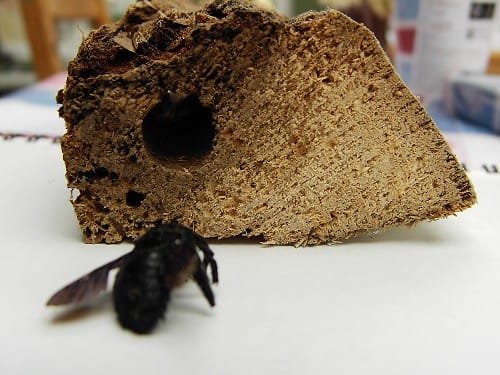
When a mated female carpenter bee selects an untreated timber, she does not chew wood at random. Using specialized rasping mandibles, she bores a perfectly circular, 1/2-inch (12.7 mm) entry hole perpendicular to the grain for roughly one inch. Then, she makes a sharp 90-degree turn and tunnels parallel to the wood grain for 6 to 10 inches.
Inside this gallery, she deposits a mass of regurgitated pollen and nectar (called “bee bread”), lays a single egg upon it, and seals the chamber with a partition made of chewed wood pulp. She repeats this process 6 to 8 times along the tunnel.
The Great Stinger Myth: Why the Hovering Bees Cannot Hurt You
The bees hovering aggressively in front of your face are males. In bees and wasps, the stinger is an anatomically modified ovipositor (egg-laying organ); therefore, male bees physically lack a stinger.
Male carpenter bees possess distinctive cream-colored or white spots on their faces and defend their territory through bluff and bluster: dive-bombing humans, pets, and competing insects. They cannot sting, bite, or puncture skin.
Female carpenter bees (all-black face) do have a stinger, but spend their days deep inside the wood gallery. Females are docile and will only sting if you physically squeeze them in your bare hand.
2. The Real Threat to Your Home: Why Woodpeckers Multiply the Damage 10x
A single carpenter bee tunnel causes minor cosmetic damage. However, leaving carpenter bee larvae inside unsealed wood attracts their primary natural predator: woodpeckers (Downy, Hairy, and Pileated woodpeckers).
Woodpeckers can hear the acoustic vibration of developing carpenter bee larvae chewing through bee bread deep inside the wood grain. To reach the fat, nutrient-dense larvae, woodpeckers use their chisel-like beaks to tear open entire fascia boards, converting clean 1/2-inch holes into jagged, 6-inch structural gouges that invite moisture rot and fungal decay.
The Homeowner Lesson: You are not just preventing carpenter bees; you are preventing woodpecker feeding damage that can cost $1,500 to $4,000 in roofline fascia and gutter replacement.
3. The Natural Timber Defense Protocol: How to Deter Them Permanently
Follow this three-step strategy to protect your deck and siding humane and permanently:
Step 1: Spray High-Concentration Citrus or Almond Oil
Carpenter bees have highly sensitive olfactory receptors. Boil citrus peels (lemons, oranges, grapefruits) in water for 30 minutes, cool the infusion, and spray directly into raw wood crevices and rafter tails. Alternatively, mix 10 drops of pure bitter almond oil with 16 oz of water. The strong aroma of d-limonene and benzaldehyde makes the wood smell toxic to nest-seeking females.
Step 2: Plug Gallery Holes in Autumn with Hardwood Dowels
Timing is critical. Do not seal active holes in early spring, or the trapped female will chew another exit hole nearby. Wait until early autumn (September–October) when the mature young bees have emerged from the gallery.
Cut a 1/2-inch wooden dowel pin into 1-inch lengths. Coat the dowel liberally with exterior waterproof wood glue (Titebond III), tap it firmly into the entrance hole with a hammer, and sand it flush with the surface.
Step 3: Seal Timber with Paint or Polyurethane
Carpenter bees heavily target unfinished, weathered softwoods (pine, fir, cedar, redwood). They actively avoid timber coated with high-solids exterior acrylic paint, high-gloss enamel, or multiple coats of marine varnish. The smooth, non-porous film masks the natural wood esters and prevents female mandibles from getting purchase on the wood grain.
4. The Myth-Buster Vault: Debunking Internet Remedies
Myth 1: “Carpenter bees eat wood for nourishment like termites.”
The Reality: Carpenter bees cannot digest cellulose or lignin. They discard all sawdust (frass) as they drill. Their sole diet consists of flower nectar and floral pollen.
Myth 2: “Filling holes with caulk or steel wool stops them.”
The Reality: Soft silicone caulk and expanding foam are easily chewed away by carpenter bees within hours. Always use solid hardwood dowels with waterproof glue to create a structural plug.
Myth 3: “Cedar wood is completely immune to carpenter bees.”
The Reality: While cedar contains natural aromatic tannins, weathered cedar fascia and shingles are among carpenter bees’ favorite nesting sites. Only hard finishes (paint/polyurethane) provide reliable protection.

About the Author: Barnaby Thorne
Editorial Pen Name & Apiary Contributor Team
Barnaby Thorne is the collective pen name of the Bee-Honey.org editorial and apiculture team. Our team combines practical woodworking and apiary craft with university agricultural extension research to help homeowners protect timber structures while preserving native pollinators. “Never poison a native pollinator when a coat of paint and a wooden dowel can solve the problem permanently.”
📚 Scientific Sources & Extension Entomological References
- Potter, M. F. (2018). Carpenter Bees. University of Kentucky College of Agriculture, Food and Environment, Extension Publication ENT-57.
- Gerstenmacker, D., & Waldvogel, M. (2020). Carpenter Bees. North Carolina State University Extension Entomology.
- Balduf, W. V. (1962). Life of the carpenter bee, Xylocopa virginica (Linnaeus). Annals of the Entomological Society of America, 55(3), 263–271.
- USDA Forest Service, Forest Products Laboratory. Wood Protection and Wood-Boring Insect Prevention. General Technical Report FPL-GTR-190.
- Howard, F. W. (1990). Carpenter bees and their control. University of Florida IFAS Extension.
Frequently Asked Questions About Carpenter Bees
Do male carpenter bees sting?
No, male carpenter bees cannot sting because they lack a stinger (which is an egg-laying organ found only in females). Despite their aggressive territorial hovering and dive-bombing behavior, males are completely harmless to humans and pets.
What wood do carpenter bees avoid?
Carpenter bees avoid dense hardwoods such as oak, maple, hickory, teak, and mahogany. They also avoid pressure-treated lumber (treated with copper-based preservatives) and composite decking materials (Trex). They strongly prefer softwoods like untreated pine, cedar, cypress, and redwood.
How do you plug carpenter bee holes permanently?
Wait until early autumn after the brood has emerged. Coat a 1/2-inch hardwood dowel pin in exterior waterproof wood glue (Titebond III), tap it firmly into the entrance hole until flush, sand the surface, and coat with exterior paint.
Will painting wood prevent carpenter bees?
Yes. Female carpenter bees rely on olfactory cues to locate soft, raw cellulose fibers. A cured coat of high-solids exterior acrylic paint or polyurethane seals the wood aroma and creates a slick surface that deters boring activity by over 95%.
Do carpenter bees return to the same hole every year?
Yes. Carpenter bees overwinter as adults inside old galleries and will reuse and expand existing tunnels in spring if they are not physically plugged with glued wooden dowels in autumn.