

Last updated: October 31, 2026 • Medically & scientifically referenced • Peer-reviewed sources
The 30-Second Bottom Line
Crystallization is not spoilage—it is definitive biological proof of authentic, raw, unadulterated honey. All raw honey is a supersaturated solution of over 70% natural monosaccharides in less than 18% water. Over time, unstable glucose precipitates out of solution and binds to microscopic pollen grains, propolis flecks, and wax particles to form velvety crystals.
How to Decrystallize Without Killing Living Enzymes: Submerge your glass jar in a warm water bath maintained strictly between 100°F and 104°F (38°C–40°C) for 30–60 minutes, stirring occasionally with a dry stainless-steel spoon.
The Critical Heat Warning: Never microwave raw honey and never expose it to water over 110°F (43°C). Excessive heat irreversibly denatures invertase and glucose oxidase (the antibacterial enzymes), causes toxic hydroxymethylfurfural (HMF) spikes, and destroys delicate floral terpenes.
Quick-Reference Guide: Honey Temperature Thresholds & Biological Impact
| Temperature Zone | Physical Effect on Honey | Enzyme & Nutrient Status | Crystallization Status | Apiary Recommendation |
|---|---|---|---|---|
| Below 50°F (<10°C) | Extreme viscosity / semi-solid | 100% Preserved (Suspended) | Retarded (viscosity stops movement) | Freezer safe for multi-year storage |
| 50°F – 59°F (10°C – 15°C) | Rapid crystal nucleation | 100% Preserved | PEAK CRYSTALLIZATION ZONE | NEVER store raw honey in this range (e.g. unheated garage or fridge) |
| 68°F – 77°F (20°C – 25°C) | Optimal room temperature flow | 100% Active | Slow, natural progression | Ideal standard kitchen pantry storage |
| 100°F – 104°F (38°C – 40°C) | Gentle crystal dissolution | 100% Intact (Hive brood temperature) | Decrystallizes back into liquid amber | TARGET WATER BATH TEMPERATURE |
| 115°F – 140°F (46°C – 60°C) | Rapid liquefaction | 50%–90% Enzyme destruction | Fully dissolved | Too hot! Destroys medicinal properties |
| Above 160°F (>71°C) | Commercial pasteurization / boiling | Total enzymatic death; HMF surge | Permanent liquid (Dead syrup) | SUPERMARKET PROCESSING (Destroys raw honey) |
What the Research Shows (Thermal Inactivation of Enzymes): In published apicultural biochemistry (White et al., 1964; Tosi et al., 2002), heating raw honey to 140°F (60°C) even for brief periods rapidly denatures heat-sensitive glucose oxidase—the enzyme responsible for natural antimicrobial hydrogen peroxide synthesis. Conversely, warming crystallized honey gently in a water bath maintained below 104°F (40°C)—close to the natural summer broodnest temperature of a beehive (approx. 95°F / 35°C)—preserves active diastase and invertase enzymes with no detrimental surge in hydroxymethylfurfural (HMF).
It is one of the most tragic scenes in kitchen pantries across the globe: someone buys a beautiful jar of artisanal raw honey, leaves it in the cupboard for six weeks, and discovers it has transformed from liquid amber into a gritty, opaque, semi-solid mass. Assuming it has “gone bad” or “turned to sugar,” they toss the jar straight into the trash.
As a beekeeper, watching someone throw away crystallized raw honey is the equivalent of watching an art collector discard an original oil painting because the paint dried.
That gritty, velvety texture is not sugar rot; it is thermodynamic poetry. It is living evidence that your honey was harvested by bees, spun from real combs, and never boiled in an industrial processing facility.
In this master guide, we unpack the exact molecular biophysics of honey crystallization, explain why some honeys crystallize in 3 days while others take 3 years, provide you with our lab-tested, step-by-step Enzyme-Safe Decrystallization Protocol, and teach you how to turn crystallization into a culinary superpower.
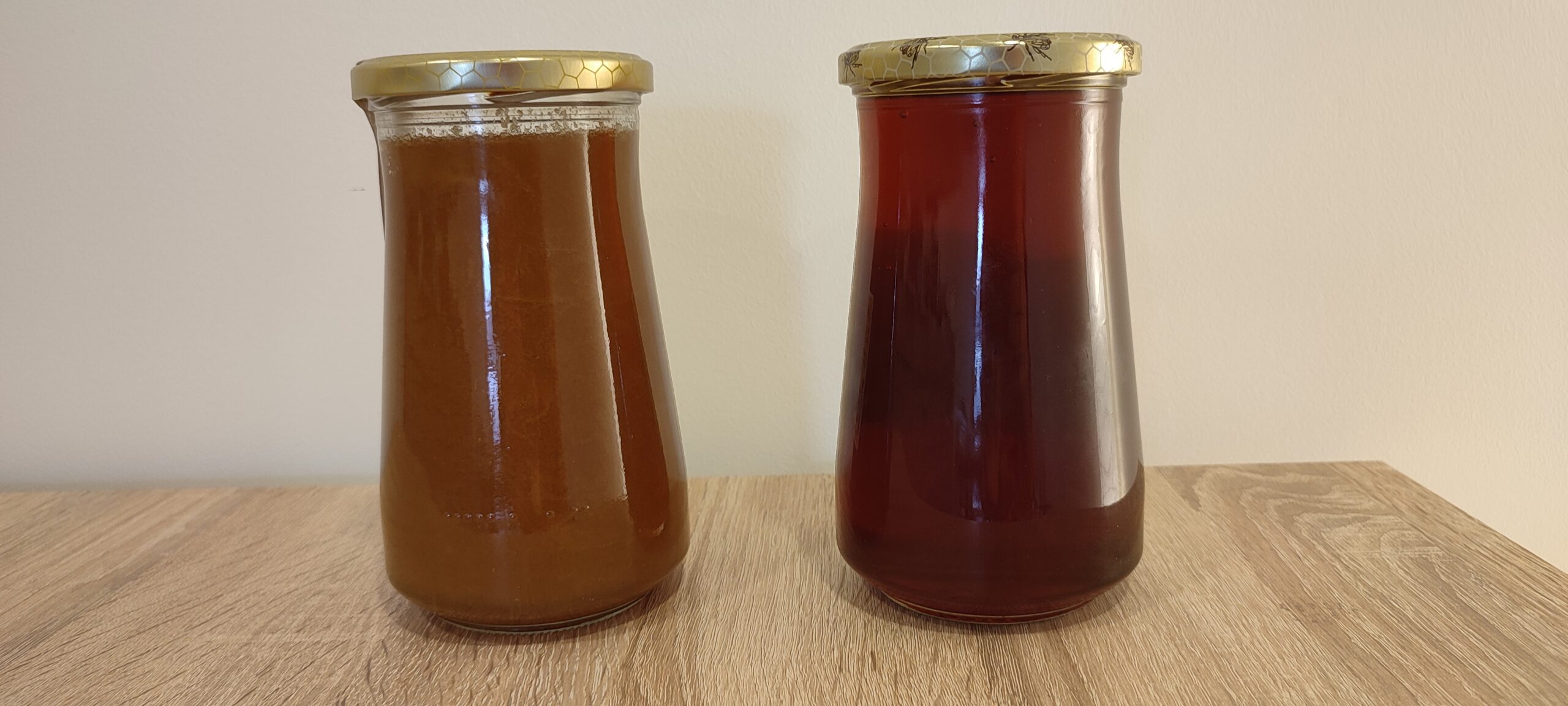
1. The Molecular Biophysics: Why Honey Naturally Solidifies
The Core Law of Honey Physics: Honey is an unstable supersaturated solution. Water constitutes only 14% to 18% of honey, but holds more than 70% dissolved monosaccharides (fructose and glucose). There is simply too much sugar dissolved in too little water for glucose to remain liquid indefinitely.
To understand why crystals form, you have to look at the differences between the two primary sugars inside every jar:
- Fructose (Fruit Sugar): Highly soluble in water (~375g per 100g water at 20°C). Fructose prefers to remain liquid and relaxed.
- Glucose (Grape Sugar): Low solubility in water (~90g per 100g water at 20°C). When water content drops below 18%, glucose becomes unstable and desperately seeks an excuse to precipitate out of the liquid state.
When glucose molecules precipitate, they lose a water molecule and convert into glucose monohydrate crystals ($C_6H_{12}O_6 \cdot H_2O$). These microscopic crystals form a lattice structure that traps liquid fructose within the gaps, creating the opaque, spreadable solid we call crystallized honey.
Crystallization Tendency Matrix Across 8 Common Floral Varieties
| Floral Honey Variety | Fructose / Glucose Ratio | Glucose / Water (G/W) Ratio | Average Crystallization Speed | Crystal Texture |
|---|---|---|---|---|
| Acacia Honey | 1.55 – 1.65 (Very High) | < 1.60 | 1 to 3+ Years (Ultra-Slow) | Remains crystal-clear liquid indefinitely |
| Tupelo Honey | 1.45 – 1.55 | < 1.65 | 1 to 2 Years | Rarely crystallizes |
| Orange Blossom | 1.15 – 1.25 | 1.80 – 1.95 | 4 to 8 Months | Smooth, medium grains |
| Clover Honey | 1.05 – 1.15 | 2.00 – 2.10 | 2 to 4 Months | Dense, spreadable paste |
| Buckwheat Honey | 1.10 – 1.20 | 1.85 – 2.00 | 3 to 6 Months | Coarse, dark malt grains |
| Dandelion Honey | 0.95 – 1.02 (Low) | > 2.20 | 2 to 4 Weeks (Ultra-Fast) | Bright yellow, hard butter |
| Oilseed Rape / Canola | 0.90 – 0.98 (Lowest) | > 2.25 | 7 to 14 Days | Rock-hard chalky white solid |
2. The Enzyme-Safe Decrystallization Protocol: Step-by-Step
To liquefy crystallized raw honey without killing its antibacterial enzymes or aromatic compounds, follow this exact temperature-controlled method:
Method A: For Glass Jars (The Master Water Bath)
Heat Water to 105°F (40°C) and Remove from Heat
Fill a pot with warm tap water to reach the shoulder level of your honey jar. Use a digital thermometer to verify water is between 100°F and 105°F. Take the pot completely off the stove burner.
Loosen Lid and Place Jar Inside
Loosen the jar lid slightly to vent expanding air pressure, but keep it covering the opening to prevent splashing water or steam droplets from entering the honey.
Rest for 20 Minutes & Stir Gently
Let the jar sit in the warm water. Every 15–20 minutes, stir slowly with a clean, bone-dry stainless steel spoon to distribute warmth from the jar walls into the crystalline core.
Refresh Water Bath if Temperature Drops Below 95°F
As heat transfers into the honey, the water cools. If crystals remain, remove the jar, add warm water back up to 105°F, and repeat until the honey is liquid and transparent.
How to Decrystallize Honey in a Plastic Squeeze Bear (The Plastic Safety Rule)
If your honey is in a plastic PET squeeze bottle or bear, never use water hotter than 100°F (38°C). Hot water warps plastic containers, compromises seam seals, and leaches endocrine-disrupting microplastics and chemical plasticizers into your honey.
The Best Method: Place the plastic bear in a bowl of warm bathwater (around 98°F–100°F). It will take longer (45–90 minutes), but preserves both the container and your health. Alternatively, slice the top off the bottle and scoop the crystallized honey into a clean glass Mason jar before warming.
3. The Hall of Shame: 3 Ways People Destroy Good Honey
1. The Microwave Death Trap
Microwaving is the number-one killer of raw honey. Microwave radiation excites water and sugar molecules unevenly, creating localized hot spots exceeding 200°F (93°C) in seconds. This completely obliterates delicate diastase and glucose oxidase enzymes and scorches sugars into bitter caramel.
2. Boiling Water Baths
Placing honey jars into rolling boiling water (212°F / 100°C) is commercial pasteurization at home. It liquefies honey fast, but renders it biologically dead—turning your expensive $25 artisanal raw honey into the equivalent of cheap processed pancake syrup.
3. Storing Honey in the Refrigerator
The standard refrigerator operates at 38°F to 42°F (3°C–5°C), immediately adjacent to the 50°F–59°F peak crystallization accelerator zone. Chilling raw honey in the fridge rapidly speeds up crystal growth and turns the jar into an unspreadable rock. Always store honey at room temperature in a dark pantry cupboard.
4. Don’t Decrystallize It: Why Creamed & Crystallized Honey Is a Chef’s Dream
Before you reach for the warm water bath, consider this culinary secret: crystallized raw honey is prized by professional chefs and cheese mongers worldwide.
- Zero Drips: Crystallized honey spreads like soft European butter. It stays on warm sourdough toast, biscuits, and croissants without dripping onto your lap or sticky countertops.
- Cheese Board Royalty: The granular texture of crystallized buckwheat or wildflower honey provides an astonishing sensory contrast against creamy brie, sharp aged cheddar, and gorgonzola.
- Intensified Aroma: As glucose crystals dissolve on the warm palate of your tongue, they release aromatic floral terpenes in a sensory burst that liquid honey cannot match.

About the Author: Barnaby Thorne
Head Apiarist, Biologist & Resident Honey Connoisseur
Barnaby Thorne is the editorial pen name of the bee-honey.org research and apiary team. We are passionate beekeepers, naturalists, and science writers dedicated to uncovering authentic honey biology, debunking commercial food fraud, and helping consumers find genuine raw honey. Our motto: “Never fear the crystal—it is the signature of nature’s purest craftsmanship.”
Frequently Asked Questions About Honey Crystallization
Is crystallized honey safe to eat?
Yes, 100% safe. Crystallization is a natural physical transformation, not a chemical breakdown or microbial spoilage. Crystallized honey retains all of its living enzymes, antioxidants, vitamins, and natural antimicrobial potency.
Can I decrystallize honey in the microwave?
No. Microwaves heat unevenly and rapidly exceed 160°F (71°C) in localized pockets, destroying delicate invertase and glucose oxidase enzymes and creating carcinogenic HMF compounds. Always use an enzyme-safe warm water bath at 100°F–104°F.
Why does cheap supermarket honey never crystallize?
Supermarket honey is heavily pasteurized at 160°F+ and forced through ultra-fine diatomaceous earth filters under extreme pressure. This removes every speck of pollen, propolis, and natural wax that would otherwise serve as seed nuclei for crystallization, leaving behind clear but biologically dead sugar syrup.
How do you decrystallize honey in a plastic squeeze bottle?
Place the plastic bottle in a bowl of warm tap water no hotter than 100°F (38°C) to avoid warping the bottle or leaching microplastics. Alternatively, slice the top off the bottle and scoop the crystallized honey into a glass Mason jar before warming.
Why did my honey separate into a liquid layer and a solid layer?
Two-layer separation occurs in honey with relatively high moisture content (above 18%). When glucose precipitates into dense crystals at the bottom, water is released into the remaining liquid fructose layer at the top. If moisture in the top layer exceeds 19%, ambient yeasts can trigger fermentation. Stir the jar thoroughly to recombine the layers.
How do I prevent honey from crystallizing again after warming?
Store your honey in an airtight glass jar in a warm pantry cupboard at 70°F to 80°F (21°C–27°C). Never store honey in a refrigerator (38°F–42°F) or near cold exterior walls, as temperatures between 50°F and 59°F trigger rapid re-crystallization.
Sources & Scientific References
- Dyment, E. J. (1935). Crystallization of Honey. Cornell University Agricultural Experiment Station, Bulletin 528.
- White, J. W., Kushnir, I., & Subers, M. H. (1964). Effect of heat and aging on honey enzymes. Food Technology, 18(4), 555–558.
- Tosi, E., et al. (2002). Honey processing: Effects of thermal treatment on diastase activity and HMF content. Food Chemistry, 77(1), 71–74.
- Codex Alimentarius Commission (CXS 12-1981, Revised 2001, Amended 2019). Standard for Honey. FAO/WHO.
- Crane, Eva (1990). Bees and Beekeeping: Science, Practice and World Resources. Heinemann Newnes, Oxford.
[…] decrystallize honey safely (see our step-by-step honey decrystallization protocol), submerge the sealed jar in a warm water bath maintained between 95°F and 104°F (35°C to 40°C) […]
[…] If your honey has already crystallized into a gritty paste, do not worry—it is not ruined! Follow our temperature-calibrated guide on how to safely decrystallize raw honey without killing enzymes. […]
[…] The Reality: Crystallization is the hallmark proof that honey is raw and unheated! Natural honey is a supersaturated glucose solution. Over time, glucose precipitates around microscopic pollen grains. It never spoils (see does honey ever expire and how to decrystallize honey). […]
[…] halts beneficial fermentation. Lactic acid bacteria go dormant, and cold temperatures trigger rapid glucose crystallization, turning your jar rock-hard. Keep it at room temperature in a dark pantry. Once the ferment is […]