

The 30-Second Bottom Line
White honey is completely natural, safe, and often one of the highest-quality raw honeys you can buy. Raw honey turns white—either solidly throughout the jar or as a thin creamy layer on top—for three distinct scientific reasons:
1. Fine Glucose Crystallization (Light Scattering): In high-glucose varietals (clover, canola, alfalfa), D-glucose naturally precipitates into microscopic monohydrate crystals. These millions of crystal facets scatter incoming light like fresh snow, turning amber liquid honey opaque ivory or pure white.
2. Naturally Pale Floral Nectars (“Water White”): Monofloral honeys from Hawaiian Kiawe (Prosopis pallida), Pacific Northwest Fireweed, and White Sage naturally lack dark carotenoid and flavonoid pigments, ranking below 8 mm on the USDA Pfund Color Scale.
3. Surface White Micro-Foam: A snowy ring on top of a fresh jar is composed of tiny trapped air bubbles, pollen grains, and beeswax flecks floating upward via buoyancy—definitive physical proof that the honey was neither high-heat pasteurized nor vacuum-deaerated.
The Bottom-Line Rule: Never throw out raw honey because it turned white or solidified! White crystallization is a prized hallmark of genuine, unheated honey. Only discard a jar if you smell sharp alcoholic vinegar notes combined with aggressive gas bubbling from fermentation.
You open the pantry door, reach for a jar of wildflower honey you bought a few months ago, and freeze. The translucent golden amber liquid has vanished. In its place sits a dense, chalk-white, opaque paste—or perhaps a distinct snowy layer of pale foam clinging to the glass rim. Has the honey gone moldy? Did an unscrupulous bottler mix in white granulated sugar or lard?
Because supermarket shoppers have been trained to expect honey to look like clear, syrupy amber inside a plastic bear, seeing snowy-white honey triggers immediate suspicion. Yet in the world of master beekeeping and gourmet apiculture, white honey is actually the gold standard of authenticity. In this guide, we uncover the optical physics of glucose crystallization, explore rare monofloral “Water White” nectars like Hawaiian Kiawe, explain the Dyce creaming method, and help you distinguish healthy white micro-foam from spoilage.
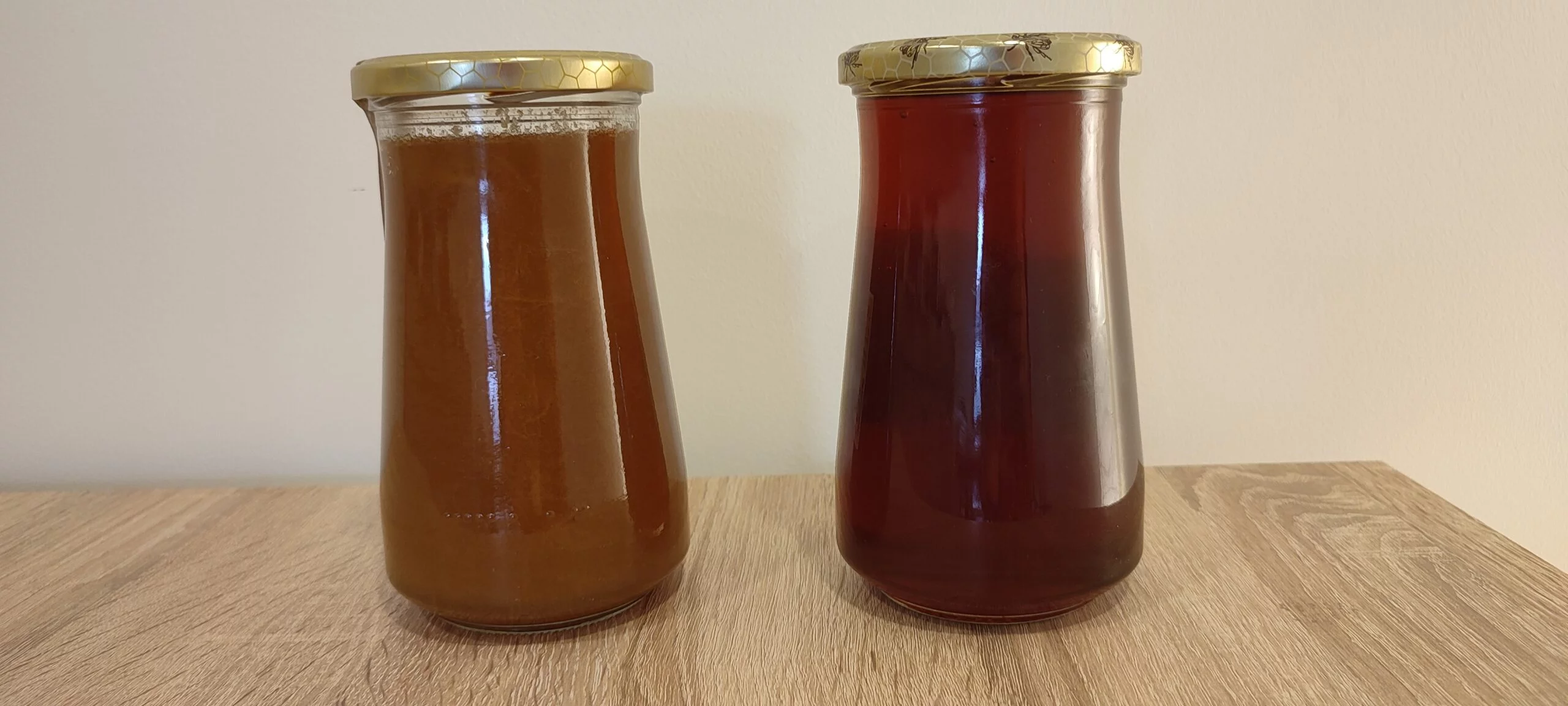
What the Research Shows: The Optics & Chemistry of White Honey
Apicultural physics and USDA grading benchmarks explain exactly why raw honey turns white:
- The Dyce Creamed Honey Method (Dyce 1931, Cornell University Bull. 528): Dr. Elton J. Dyce discovered that seeding liquid honey with ~10% fine crystals and holding it at \(57^\circ ext{F}\) (\(14^\circ ext{C}\)) forces rapid formation of ultra-fine glucose monohydrate micro-crystals (\(<20 ext{ microns}\)), yielding a smooth, spreadable, pearly-white texture.
- USDA Pfund Color Scale (7 CFR § 52.1391): Honey color is quantitatively measured in millimeters on the Pfund grader. “Water White” honey measures 0 to 8 mm, “Extra White” measures 8 to 17 mm, and “White” measures 17 to 34 mm—reflecting natural variations in nectar flavonoids and minerals.
- Glucose-to-Water Solubility Kinetics (White 1978): Because honey is supersaturated (~70% sugars in ~17% water), excess D-glucose cannot remain permanently dissolved. The higher the glucose-to-water (G/W) ratio (> 2.0), the faster the honey turns white.
1. Reason #1: Optical Light Scattering from Glucose Crystallization
Most white honey is actually amber honey whose crystals scatter light. Just as liquid water is transparent while frozen crushed ice or snowflakes appear brilliantly white, the transition of honey from liquid to solid alters how light interacts with its molecular matrix.
Honey contains two primary sugars: fructose (which resists crystallization and remains dissolved) and glucose (which has much lower water solubility). In unheated raw honey, free glucose molecules gradually precipitate out of the water matrix and lock together into solid crystals of alpha-D-glucose monohydrate, forming around microscopic specks of floral bee pollen.
When light enters a jar of liquid honey, it passes smoothly through the uniform fluid, showing the golden or amber hue of its plant pigments. When millions of microscopic glucose crystals form, incoming light bounces and scatters randomly off thousands of tiny crystalline interfaces—a phenomenon known as diffuse reflection. The finer and more numerous the crystals, the brighter and whiter the honey appears!
To understand why certain floral varietals solidify in weeks while others remain liquid for years, read our complete thermodynamic guide on why honey crystallizes and how to safely decrystallize it.
2. Reason #2: Rare “Water White” Monofloral Nectars (Kiawe & Fireweed)
Certain botanical blooms produce honey that is naturally white or nearly colorless before it even begins to crystallize. The natural color of honey is dictated almost entirely by trace minerals (iron, copper, manganese) and botanical pigment compounds (carotenoids, chlorophyll derivatives, and flavonoids) inside the flower’s nectar.
While dark buckwheat and chestnut honeys are packed with heavy mineral salts and dark phenolic pigments, light floral blooms yield honey classified as “Water White” or “Extra White” on the USDA Pfund Color Scale:
Hawaiian Kiawe (Mesquite)
Harvested from Prosopis pallida trees along the arid Kona coast of Hawaii, Kiawe honey naturally crystallizes rapidly in the hive frames into an extraordinarily smooth, opaque, butter-like pearly white solid.
Pacific Northwest Fireweed
Produced from the nectar of Chamaenerion angustifolium (which blooms in logged or post-wildfire clearings), Fireweed honey is legendary for its ultra-pale champagne tint and clean, delicate floral notes.
White Clover & Canola
Northern Plains clover and Brassica (canola/rapeseed) honeys have high glucose-to-fructose ratios (~1:1), causing them to rapidly set into solid white jars—often sold as spreadable “creamed honey.”
3. Reason #3: The White Foam Layer on Top of Your Jar
A thin ring of white foam floating at the surface of raw honey is a prized sign of unprocessed authenticity, not spoilage. When beekeepers extract honey without high-heat thermal pasteurization or industrial vacuum chambers, tiny air bubbles become trapped inside the viscous liquid during uncapping and straining.
Over days and weeks in the jar, those microscopic air bubbles slowly rise to the top due to buoyancy, carrying along minute traces of natural beeswax, propolis proteins, and floral pollen particles. Together, they form an airy, sweet, ivory-white foam collar directly beneath the lid.
Because commercial packers flash-pasteurize their honey at \(160^\circ ext{F}\) and micro-filter out pollen, commercial “pure” honey rarely exhibits surface foam. Check our deep comparison on whether raw honey is the same as pure honey to see how industrial handling removes this signature trait.
4. White Honey Diagnosis Matrix: Crystallization vs Foam vs Fermentation vs Mold
If you are looking at a white layer or pale mass inside your jar and want to be 100% certain it is safe to eat, compare it against these four physical diagnostics:
| Visual Appearance | Underlying Cause | Texture & Aroma | Safety Verdict |
|---|---|---|---|
| Solid Ivory / Pale Paste | Fine glucose crystallization (or Dyce creamed) | Thick, creamy, or slightly grainy; sweet floral aroma | 100% Safe & Ideal Raw Quality |
| White “Frosting” on Glass | Tiny air pockets shrinking away from glass during crystallization | Dry feather-like white patterns along jar walls | 100% Safe (Sign of low moisture) |
| Thin White Surface Collar | Trapped micro-air bubbles, pollen & wax flecks | Light, frothy, marshmallow-like; sweet nectar scent | 100% Safe (Unpasteurized sign) |
| Expanding Froth + Hiss | Wild yeast fermentation (moisture >19%) | Runny liquid, CO2 fizz, sour/yeasty wine smell | Fermented (Non-toxic, sour taste) |
| Fuzzy Green/Black Spots | Surface mold from external food/water contamination | Fuzzy mycelial growth, musty smell | Discard Immediately (Contaminated) |
5. The Myth-Buster Vault: White Honey Misconceptions
Myth: “White honey has been bleached or blended with white cane sugar.”
The Chemistry Reality: Bleaching honey is illegal and destroys its flavor, and adding dry white table sugar (sucrose) fails to dissolve cleanly into honey. White honey gets its color organically from ultra-fine natural glucose crystals scattering light—something supermarket brands like Kirkland and Aunt Sue’s frequently display, as examined in our store-bought raw honey review.
Myth: “Creamed white honey has dairy butter or whipped cream mixed in.”
The Culinary Reality: Authentic creamed honey (also called spun honey or whipped honey) contains zero dairy, zero cream, and zero fat. It is 100% pure honey whose crystallization was carefully guided at \(57^\circ ext{F}\) using the Dyce process so the glucose crystals remain microscopically smooth on the tongue.
Myth: “Put crystallized white honey in the refrigerator to keep it smooth.”
The Storage Reality: Refrigeration (\(38 ext{–}45^\circ ext{F}\)) increases viscosity and speeds up erratic crystal growth, turning honey rock-hard. Always store raw honey at steady room temperature (\(65 ext{–}75^\circ ext{F}\)), as explained in our guide on should raw honey be refrigerated after opening.
6. How to Handle White Raw Honey in the Kitchen
Whether you embrace the creamy solid state or prefer pourable liquid honey, follow these three culinary guidelines:
- Spread It Directly as-is: White crystallized honey is spreadable without dripping off toast, English muffins, or warm croissants. Many beekeepers deliberately leave clover honey white for this clean table texture.
- Gently Reliquefy Below \(104^\circ ext{F}\): If you want pourable golden honey back, place the glass jar in a warm water bath heated strictly to \(100 ext{–}104^\circ ext{F}\) (\(38 ext{–}40^\circ ext{C}\)). Stir gently for 30 minutes until crystals re-dissolve without denaturing living diastase enzymes. Never microwave it.
- Keep Bread Crumbs Out: Never dip a buttery knife or wet spoon into a jar of white honey. Introducing bread crumbs or water droplets creates localized high-moisture pockets where surface mold can colonize.
Scientific Sources & References
- Dyce, E. J. (1931): Fermentation and Crystallization of Honey. Cornell University Agricultural Experiment Station Bulletin 528. Foundational research establishing controlled micro-crystallization (“Dyce Method”).
- United States Department of Agriculture (USDA) (1985): United States Standards for Grades of Extracted Honey. 7 CFR Part 52, § 52.1391–52.1401. Defining the Pfund Color Scale (Water White, Extra White, White).
- White, J. W. Jr. (1978): “Honey.” Advances in Food Research, Vol. 24, Academic Press, pp. 287–374. Glucose-to-water ratios and alpha-D-glucose monohydrate nucleation kinetics.
- Crane, E. (1990): Bees and Beekeeping: Science, Practice and World Resources. Heinemann Newnes, Oxford. Optical properties, honey foam physics, and floral pigment chemistry.
Last updated: 2026-11-11

About the Author: Barnaby Thorne
Barnaby Thorne is the editorial pen name of the Bee-Honey.org research and beekeeping collective. Our team brings together apiarists, food physicists, and apiculture writers committed to explaining real hive biology without myths or guesswork.
[…] chalky white (learn more in our why raw honey turns white guide) […]