

Last updated: October 31, 2026 • Medically & scientifically referenced • Peer-reviewed sources
Veterinary Guidance & Pet Safety Disclaimer
The information in this guide is for general educational purposes and does not establish a veterinarian-client relationship. Honey should never be given to puppies under 12 months, diabetic dogs, or obese animals, and must never contain artificial sweeteners like xylitol (lethal to dogs). If your dog has a persistent cough, difficulty breathing, or sudden illness, consult a licensed veterinarian immediately. Review our full Medical & Veterinary Disclaimer.
The 30-Second Bottom Line
Yes, adult dogs can safely eat pure raw honey in strict moderation. Natural honey is packed with beneficial enzymes, flavonoids, and antimicrobial compounds. Veterinarians frequently recommend honey as a natural demulcent to soothe the hacking spasms of kennel cough, as an environmental allergy desensitizer, and topically as an antibacterial dressing for canine burns and hot spots.
General Literature Guidelines: In veterinary references, suggested intake ranges from ½ to 1 teaspoon per 20–30 pounds of body weight, no more than once or twice daily. Always consult your vet first.
⚠️ 3 Critical Warnings:
1. Never feed to puppies under 12 months (immature digestive systems risk infant botulism).
2. Avoid in diabetic or severely obese dogs due to rapid fructose/glucose absorption.
3. Check the label for Xylitol (Birch Bark Sweetener): Cheap commercial honey blends cut with artificial sweeteners are acutely toxic and fatal to canines.
If you live with a dog, you know the sound: the distinctive, hollow, goose-honk cough of a dog with kennel cough, or the frantic sound of a pup licking an itchy paw at 2:00 AM. In both moments, pet owners desperately search their kitchen pantries for a gentle, natural solution that doesn’t involve heavy pharmaceuticals.
Inevitably, the eye lands on the honey jar. But is it safe? Could raw honey trigger fatal botulism? Could the sugars rot their teeth or provoke acute pancreatitis?
As a biologist, apiarist, and longtime dog companion (my terrier mix, Buster, has spent eight years keeping a respectful 30-yard perimeter around my apiary), I have witnessed firsthand how raw honey can be a veterinary miracle when used properly—and an expensive disaster when mishandled.
Canine physiology is remarkably different from human physiology. Dogs do not produce salivary amylase to break down carbohydrates in their mouths, and their digestive tracts are significantly shorter and more acidic than ours.
In this definitive guide, we will examine the canine metabolic science of honey, break down clinical studies on kennel cough relief and wound healing, provide our Veterinary Serving Reference Guide, and expose the counterfeit honey ingredients that every pet parent must avoid.
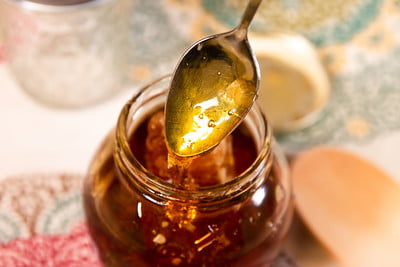
Veterinary medicine literature and clinical pharmacology establish clear guidelines for when raw honey is beneficial for canines—and when it is hazardous:
- Kennel Cough Demulcent Relief: For mild, uncomplicated Canine Infectious Respiratory Disease Complex (CIRDC), veterinarians recognize raw honey as an effective natural demulcent. Its thick viscosity forms a protective coating over irritated pharyngeal and tracheal tissues, soothing the tickling sensation that triggers repetitive dry hacking fits.
- Veterinary Wound Healing: Clinical studies in veterinary surgery (Mathews & Binnington, 2002) validate medical-grade honey for topical canine wound dressings, accelerating granulation and providing osmotic antimicrobial action without cellular toxicity.
- Lethal Toxin Alert (Xylitol): Counterfeit syrups and flavored honey products sometimes contain artificial sweeteners, particularly xylitol (birch bark extract). In canines, xylitol triggers an immediate, massive insulin surge causing severe hypoglycemia and acute liver failure. Never feed a dog honey with unverified ingredients.
- Puppy Botulism & Diabetic Dogs: Raw honey must never be given to puppies under 1 year of age due to the risk of Clostridium botulinum spore germination in immature canine gut flora. Dogs with diabetes or obesity should avoid honey due to simple sugar content.
1. Canine Metabolic Physiology: How Dogs Process Honey Sugars
To use honey safely with canines, you have to understand the evolutionary biology of the domestic dog (Canis lupus familiaris).
The Core Biological Difference: Salivary Amylase vs. Duodenal Digestion
Humans begin digesting carbohydrates the second food enters our mouths via salivary amylase. Dogs do not possess salivary amylase. Their saliva is purely a lubricant and antimicrobial wash designed for tearing and swallowing meat.
When a dog swallows honey, the sugars bypass oral digestion entirely and enter a highly acidic canine stomach (resting pH 1.0 to 2.0). Digestion of honey’s simple monosaccharides (fructose and glucose) takes place exclusively in the small intestine via pancreatic enzymes.
Because authentic raw honey consists of pre-converted monosaccharides (fructose and glucose) rather than complex sucrose, it requires almost zero digestive breakdown. It is absorbed rapidly into the portal vein.
In an active, healthy adult dog, this provides a gentle, bioavailable glycogen recharge. But if given in excessive quantities, that rapid carbohydrate influx can overwhelm the canine pancreas, triggering osmotic diarrhea or aggravating subclinical pancreatitis. Moderation is not a suggestion—it is a physiological boundary.
2. The 3 Proven Clinical Uses for Dogs
Kennel Cough (CIRDC)
Canine Infectious Respiratory Disease Complex causes violent, dry tracheal spasms. Honey functions as a physical demulcent: its viscous texture coats the pharyngeal mucosa, desensitizing hyper-reactive cough receptors while hydrogen peroxide inhibits Bordetella bronchiseptica.
Topical Hot Spots & Wounds
Dogs obsessively lick conventional antibiotic creams, risking systemic toxicity. High-grade raw or medical-grade Manuka honey creates an osmotic barrier that draws lymph fluid outward, clears bacterial biofilms, and is 100% non-toxic when licked.
Seasonal Environmental Allergies
Authentic local raw honey contains microscopic airborne pollens. Daily micro-dosing introduces low-level antigens to the gut-associated lymphoid tissue (GALT), helping desensitize canines suffering from seasonal histamine flare-ups and itchy skin.
3. Canine Honey Serving Guide by Body Weight (Veterinary Literature Reference)
Never guess honey servings for dogs. A Chihuahua and a Great Dane possess radically different pancreatic capacities. Use this standardized veterinary guide:
Administration Tip: Do not mix honey into their water bowl; it will sink to the bottom and ferment. Instead, let your dog lick the honey directly from a clean stainless-steel spoon. The thick liquid coats the back of the tongue and pharyngeal walls directly.
4. When Is Honey Dangerous for Dogs? (The 4 Red Flags)
🚨 RED FLAG 1: Adulterated Honey & The Xylitol Threat
Pure bee honey never contains artificial sweeteners. However, cheap counterfeit honey blends, flavored “honey syrups,” and sugar-free dietary honeys are frequently sweetened with Xylitol (also labeled as Birch Bark Extract, Wood Sugar, or E967). In dogs, xylitol triggers an immediate, massive release of insulin, plunging blood glucose to fatal hypoglycemic levels and inducing acute hepatic (liver) necrosis within 30 minutes. Always inspect the ingredient list: it must read 100% Pure Honey and nothing else.
RED FLAG 2: Puppies Under 1 Year Old
Just as we highlighted in our infant botulism medical guide, young puppies under 12 months do not possess a sufficiently mature gastrointestinal microbiome or high gastric acidity. Dormant Clostridium botulinum endospores can colonize a puppy’s intestines and release neurotoxins, resulting in ascending flaccid paralysis. Never give honey to young puppies.
RED FLAG 3: Diabetic & Severely Obese Dogs
Honey is roughly 80% natural sugars. In dogs diagnosed with Type 1 or Type 2 canine diabetes, honey will cause rapid blood glucose fluctuations. The only exception is under explicit veterinary instruction during an acute hypoglycemic shock episode (where a teaspoon of honey rubbed onto the gums can be life-saving).
RED FLAG 4: Systemic Bee Venom Hypersensitivity
If your dog has ever suffered an anaphylactic reaction (facial swelling, collapse, hives) after being stung by a bee, exercise extreme caution. Trace bee proteins and microscopic hive particulates in raw honey can occasionally provoke allergic responses in hyper-sensitized animals.
5. The Canine Myth-Buster Vault
Myth 1: “Adult dogs will get botulism from raw honey.”
The Reality: Untrue. A healthy adult dog’s gastric environment is extraordinarily hostile to bacteria. Canine stomach acid registers between pH 1.0 and 2.0 (substantially more acidic than adult humans), designed to destroy pathogens on raw bones and carrion. Spores cannot germinate or survive in this acidic furnace.
Myth 2: “Any supermarket honey bear works for dog wounds.”
The Reality: Absolutely false. Commercial plastic-bear honey has been heat-pasteurized and ultra-filtered, destroying glucose oxidase enzymes and antibacterial compounds. Applying dead, pasteurized syrup to an open hot spot simply coats the wound in sticky sugar that feeds fungal and bacterial pathogens. Only use medical-grade gamma-irradiated honey or unheated raw honey with verified bioactivity.
Myth 3: “Honey is toxic to dogs like chocolate or grapes.”
The Reality: Pure honey contains zero theobromine (chocolate) or tartaric acid (grapes). It is completely non-toxic to dogs. The only true danger comes from artificial sweeteners (xylitol) or gross overfeeding leading to obesity.

From the Apiary of Barnaby Thorne
Editorial Pen Name & Apiculture Team at bee-honey.org
“Whenever Buster manages to pick up kennel cough from the local dog park, my first instinct is never an over-the-counter chemical syrup. A half-teaspoon of dark raw honey (such as antioxidant-rich buckwheat honey) licked right off the spoon stops the dry spasms within minutes. Just remember: measure by weight, keep it away from puppies, and never touch anything containing xylitol.”
Sources & Scientific References
- Mathews, K. A., & Binnington, A. G. (2002). Wound management using honey. The Canadian Veterinary Journal, 43(12), 960–962.
- American Kennel Club (AKC). Can Dogs Eat Honey? Benefits, Risks, and Safe Dosing. AKC Canine Health Advisory.
- Piscitelli, C. M., et al. (2010). Xylitol toxicity in dogs. Compendium: Continuing Education for Veterinarians, 32(2), E1–E4.
- Ford, R. B. (2012). Canine Infectious Respiratory Disease Complex (Kennel Cough). In: Greene, C. E. (Ed.), Infectious Diseases of the Dog and Cat, 4th ed., Elsevier Saunders.
- Molan, P. C. (2001). Why honey is effective as a medicine: 2. The scientific explanation of its effects. Bee World, 82(1), 22–40.