

Last updated: October 31, 2026 • Medically & scientifically referenced • Peer-reviewed sources
The 30-Second Bottom Line
No, raw honey should never be refrigerated after opening. Storing raw honey in a household refrigerator (typically 35°F to 40°F / 2°C to 4°C) places it squarely into the thermodynamic “danger zone” for rapid crystal nucleation, turning silky liquid honey into a rock-hard, unspreadable block within weeks.
Why Honey Never Spoil at Room Temperature: Pure raw honey has an ultra-low moisture content (below 18%), an osmotic water activity (aw) around 0.55 to 0.60, and an acidic pH between 3.4 and 4.5. This hypertonic environment naturally dehydrates and kills airborne bacteria and mold via osmotic pressure. It needs no cold preservation.
The Golden Storage Rule: Keep raw honey in an airtight glass jar in a dark, dry kitchen cupboard or pantry at 65°F to 75°F (18°C to 24°C), well away from moisture and direct sunlight.
It is a scene I witness in nearly every friend’s kitchen: I open the refrigerator to grab some milk, and there it sits on the middle shelf—a neglected jar of artisanal raw wildflower honey, turned chalky, pale, and frozen solid like a block of concrete.
When I ask why it is in the fridge, the answer is always identical: “Well, Barnaby, I broke the safety seal and opened it. Everything spoils once you open it, right?”
Modern grocery conditioning has taught us that food preservation begins and ends with the compressor hum of a refrigerator. From mayonnaise to maple syrup, breaking a vacuum seal usually means racing against mold spores and microbial colonization. But raw honey does not play by the rules of ordinary food. It is an evolutionary marvel created by honeybees (Apis mellifera) engineered specifically to resist bacterial growth and microbial decay for decades—even millennia—without a single watt of electricity.
In this master guide, we will examine the physics of crystal nucleation, why refrigeration accelerates crystallization rather than stopping it, the exact room-temperature storage parameters that preserve delicate floral enzymes, and what to do if you have already chilled your liquid gold into a stubborn brick.
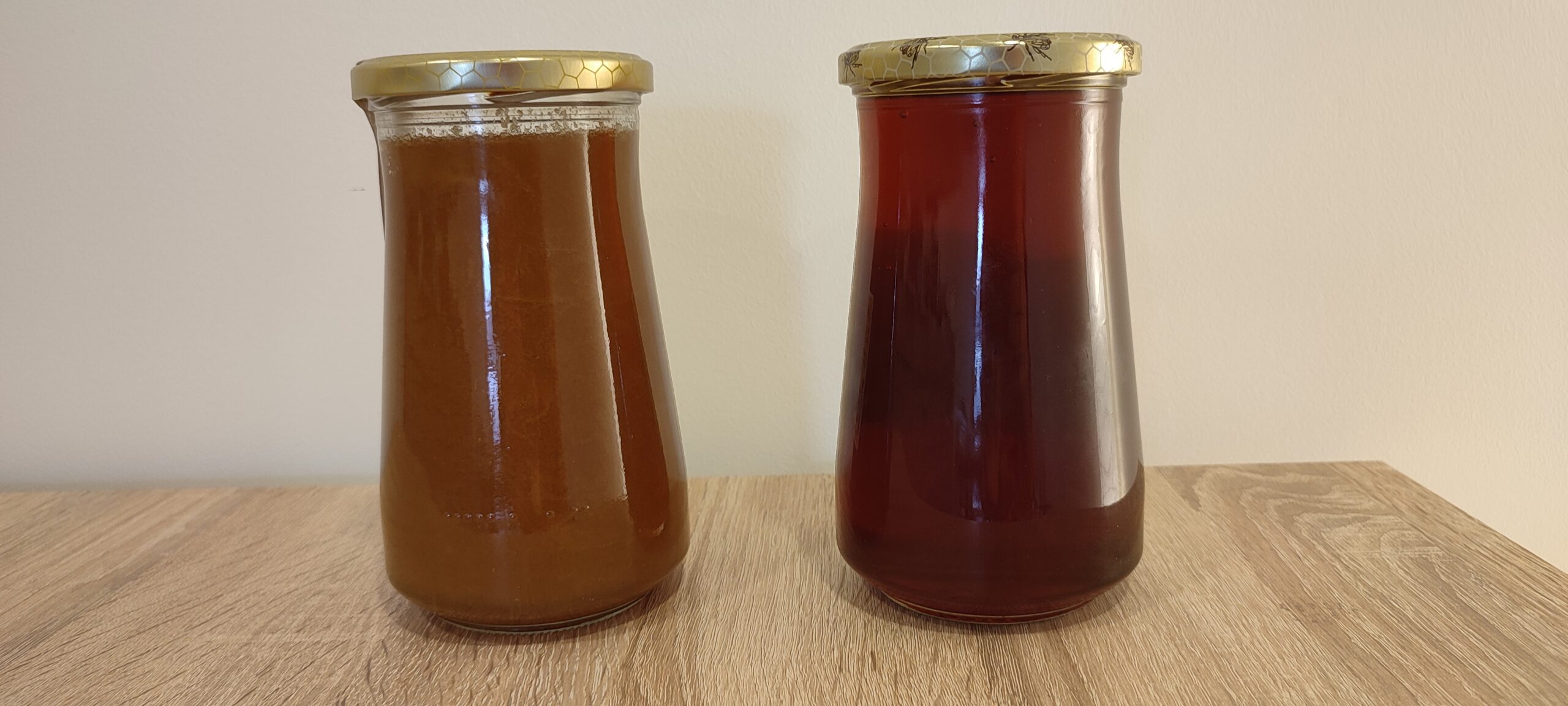
Decades of apicultural research (Dyment 1935, White 1975, Crane 1990) establish the precise thermodynamic behavior of honey across temperature ranges:
- The Crystallization Bell Curve (Dyment, 1935): Glucose monohydrate crystal nucleation accelerates sharply between 10°C and 15°C (50°F to 60°F), with maximum crystallization velocity occurring at approximately 14°C (57°F). Placing honey in cool cellars or letting it sit in cold kitchen corners forces it directly into this peak crystallization zone.
- Refrigeration & Condensation Risks: While temperatures below 5°C (41°F) drastically slow crystal growth by increasing fluid viscosity, domestic refrigeration introduces a major biological hazard: atmospheric condensation. Because honey is highly hygroscopic, surface water absorption can elevate moisture above 19%, allowing osmophilic yeasts (Zygosaccharomyces rouxii) to multiply.
- The Ideal Storage Zone: Unheated raw honey stored in an airtight glass container at ambient room temperature (18°C to 24°C / 65°F to 75°F) remains stable for years, preserving active diastase and invertase enzymes without thermal degradation or accelerated crystallization.
1. The 3 Natural Shields That Make Cold Storage Unnecessary
Raw honey does not spoil at room temperature because it possesses three inherent biochemical defenses: osmotic dehydration, acidic pH, and hydrogen peroxide generation. Microorganisms require free water and neutral pH to survive; raw honey starves them of both.
Hyperosmotic Pressure (Water Activity)
Honeybees fan their wings over nectar cells until moisture drops below 18%. This creates a water activity (aw) of 0.55–0.60. Bacteria require a minimum of 0.91 aw to multiply. Any bacterium falling into raw honey has its cellular moisture sucked out via osmosis, causing immediate plasmolysis.
Acidic pH (Gluconic Acid)
During nectar ripening, bee hypopharyngeal glands secrete the enzyme glucose oxidase, converting glucose into gluconic acid. This drops honey’s pH to between 3.4 and 4.5—similar to tomato juice or wine. Common foodborne pathogens cannot replicate in such an acidic environment.
Endogenous Hydrogen Peroxide
The same enzymatic conversion that produces gluconic acid also produces minute, continuous trace quantities of hydrogen peroxide (H2O2). This sterile biochemical tripwire cleanses the honey matrix from within, ensuring total stability at standard ambient room temperatures.
Because of this triple-layer biological force field, raw honey has no microbiological need for refrigeration. Archaeologists excavating King Tut’s tomb in Egypt famously unearthed 3,000-year-old clay vessels of honey that were still completely unspotted by bacteria and chemically preserved. It had survived thousands of Egyptian desert summers without spoiling—so your kitchen cabinet at 70°F is more than sufficient. For a deeper breakdown of this chemistry, read our complete guide on how honey storage science works.
2. The Physics of Crystallization: Why the Fridge Is the Worst Place
Refrigeration drastically accelerates honey crystallization because 50°F to 59°F (10°C to 15°C) is the thermodynamic peak for glucose crystal growth. Household fridges hover just below this range, supercooling the supersaturated sugar solution and rapidly triggering crystal nucleation.
Raw honey is fundamentally a supersaturated solution: it contains roughly 80% natural sugars (primarily glucose and fructose) suspended in less than 20% water. Chemically speaking, there is far more sugar dissolved than water should naturally be able to hold at room temperature.
Fructose is naturally highly soluble and happily stays dissolved in water. Glucose, however, is much less soluble. When glucose separates from water, it forms tiny crystal seeds (called dextrose monohydrate crystals). The rate at which these crystals multiply is dictated entirely by temperature:
As you can see, household refrigeration puts raw honey directly adjacent to the 50°F–59°F peak nucleation window. In contrast, if you place raw honey in a deep freezer below 0°F, crystallization paradoxically stops because the liquid enters an amorphous “glass transition” state where molecules cannot move to organize into a crystal lattice. But for everyday eating, a dry, dark kitchen cabinet at standard room temperature is the undisputed winner.
If your honey has already crystallized into a gritty paste, do not worry—it is not ruined! Follow our temperature-calibrated guide on how to safely decrystallize raw honey without killing enzymes.
3. The 2 Real Threats: Refrigerator Moisture Traps & Odor Leaks
Beyond hardening your honey, refrigerators introduce two serious chemical risks: moisture absorption (which can trigger fermentation) and volatile odor contamination. Honey is an aggressive hygroscopic sponge that pulls water vapor and ambient smells straight from the air.
⚠️ The Condensation Trap: When you remove a cold honey jar from the fridge into a warm kitchen, atmospheric moisture immediately condenses on the cold glass rim and honey surface. If you seal the jar, this water dilutes the top layer past the critical 18% moisture threshold, allowing dormant wild osmophilic yeasts (Zygosaccharomyces) to awaken and ferment your honey into sour mead.
Additionally, raw honey contains complex lipid and wax fractions that readily bind lipophilic scent molecules. Put an improperly sealed honey jar next to cut onions, strong cheeses, or last night’s salmon in the fridge, and within 48 hours your delicate acacia honey will taste distinctly like a delicatessen cold room.
4. The “Kitchen Counter Lab”: 4 Rules for Perfect Storage
To preserve raw honey’s active enzymes, delicate floral aromatics, and liquid texture indefinitely, store it in an airtight glass container at room temperature away from light and steam. Follow these 4 practical pantry rules:
1. Glass Over Plastic
Always prefer heavy glass jars over squeezable polyethylene plastic bottles. Standard plastic is gas-permeable over time, allowing moisture and oxygen to slowly migrate into the honey and alter its volatile aroma compounds.
2. The Airtight Gasket
Wipe the rim clean of honey drips before sealing. Dried honey on the jar threads prevents a hermetic seal, creating microscopic air leaks that suck humidity out of humid kitchen air on rainy days.
3. Avoid Heat Vents & Stoves
Never store honey directly above the oven, dishwasher, or on a sunlit windowsill. Repeated heat cycling accelerates hydroxymethylfurfural (HMF) formation and deactivates heat-sensitive antibacterial enzymes.
4. The “Dry Spoon” Mandate
Never dip a wet, buttered, or tea-dunked spoon into the jar. Introducing even a half-teaspoon of external water or bread crumbs provides localized surface moisture for wild yeasts to bloom.
5. The Myth-Buster Vault: Honey Storage Edition
❌ Myth: “Raw honey has an expiration date, and the fridge keeps it fresh longer.”
The Reality: Expiration dates on honey jars are mandatory commercial packaging regulations, not biological realities. Because of honey’s osmotic pressure and lack of free water, it simply cannot support bacterial growth at room temperature. Refrigerating honey only hardens it without extending its already indefinite shelf life.
❌ Myth: “If my honey crystallizes in the pantry, it means it has gone bad or was cut with fake sugar.”
The Reality: In fact, the exact opposite is true! Crystallization is the hallmark of genuine, unpasteurized raw honey. Ultra-filtered commercial syrups are stripped of microscopic pollen grains and heated to high temperatures specifically to prevent crystallization on supermarket shelves. Pure raw honey naturally crystallizes over time due to natural glucose content.
❌ Myth: “Creamed honey must be kept in the fridge to stay creamy.”
The Reality: Creamed honey (spun honey) has billions of microscopic, controlled glucose micro-crystals that create a spreadable butter-like consistency. It remains perfectly stable at cool room temperature (65°F–68°F / 18°C–20°C). Putting it in the fridge makes it rock hard and tears your toast; keeping it too warm (above 78°F) causes it to liquefy.
❌ Myth: “Medical Manuka honey should be refrigerated to preserve its MGO rating.”
The Reality: Methylglyoxal (MGO) is remarkably thermo-stable compared to delicate hydrogen peroxide enzymes. As long as you keep your Manuka honey below 75°F (24°C) in a dark cupboard, MGO concentrations remain potent for years without refrigeration.

Written by Barnaby Thorne
Editorial Pen Name & Apiculture Team | bee-honey.org
“Bees spent millions of years fine-tuning the thermodynamics of the hive to keep honey stable without electricity. Trust their biology: give your raw honey a dry pantry shelf, keep the lid tight, and leave the refrigerator for the butter.”
Sources & Scientific References
- Dyment, E. J. (1935). Crystallization of Honey. Cornell University Agricultural Experiment Station, Bulletin 528.
- White, J. W. (1975). Physical characteristics of honey. In: Crane, E. (Ed.), Honey: A Comprehensive Survey, Heinemann, London, pp. 207–239.
- Lochhead, A. G., & Heron, D. A. (1929). Microbiological studies of honey: I. Honey fermentation and its cause. Dominion of Canada Department of Agriculture, Bulletin 116.
- Bogdanov, S., et al. (1999). Honey quality and international regulatory standards: Review by the International Honey Commission. Bee World, 80(2), 61–69.
- Crane, Eva (1990). Bees and Beekeeping: Science, Practice and World Resources. Heinemann Newnes, Oxford.
[…] your medicinal honey jar at room temperature in a dark cupboard. As detailed in our guide on refrigerating raw honey, cold fridges cause rapid crystal hardening that makes daily spoon dosing frustratingly […]
[…] refrigerate either honey! As detailed in our guide on why raw honey must never be refrigerated, cold temperatures destroy Sidr’s rich aroma and force even high-fructose Acacia to form […]
[…] The Storage Reality: Never refrigerate honeycomb! Temperatures between (50 ext{–}57^circ ext{F}) dramatically accelerate glucose crystallization, turning the liquid cells gritty and solid. Furthermore, refrigeration makes the wax walls brittle. Keep honeycomb sealed in an airtight container at room temperature in a dark pantry. Learn more in our guide on refrigerating raw honey after opening. […]