

The 30-Second Bottom Line (For Busy Humans Holding a Suspicious Jar)
Pure, properly sealed honey never expires. Because bees dehydrate nectar down to under 18.6% moisture (a water activity below 0.60 aw) and infuse it with acidic enzymes (pH 3.9), bacteria and mold physically implode on contact.
What’s happening in your jar right now:
• Solid, grainy, or rock-hard? That is natural crystallization—a badge of authentic raw honey. Fix it in a 104°F (40°C) warm water bath.
• Dry white foam or ring at the top? Harmless trapped air bubbles, microscopic pollen, and beeswax rising to the surface. 100% safe to eat.
• Bubbly, sour-smelling, or separated into a dark runny layer that hisses when opened? Excess moisture got in and triggered wild yeast fermentation. Safe for healthy adults to bake or cook with (it’s basically nascent mead!), unless you see fuzzy surface mold or foul rot.
Every autumn, my inbox fills up with photos from panicked honey lovers holding up jars from the back of their pantry like crime-scene evidence. “Barnaby, my honey turned into pale yellow concrete!” “Why is there a weird white foam floating on top?” “It separated into two layers—will this send me to the emergency room?”
Take a deep breath and step away from the trash can. Almost 95% of the honey people throw away each year is not only completely safe to eat—it is actually proving right in front of your eyes that it is genuine, unpasteurized raw honey rather than ultrafiltered supermarket corn syrup.
In 1922, when archaeologists unsealed King Tutankhamun’s tomb in Egypt, they discovered ceramic pots of 3,300-year-old honey that were still chemically unspoiled. Yet if you leave a lid slightly loose in a humid Florida kitchen for three weeks, that “immortal” honey can start fizzing like a microbrewery.
Grab a clean spoon. Let’s look inside your jar through the eyes of a hive biologist, diagnose every strange texture and smell from white foam to two-layer separation, and learn how to bring crystallized honey back to liquid gold without destroying a single living enzyme.
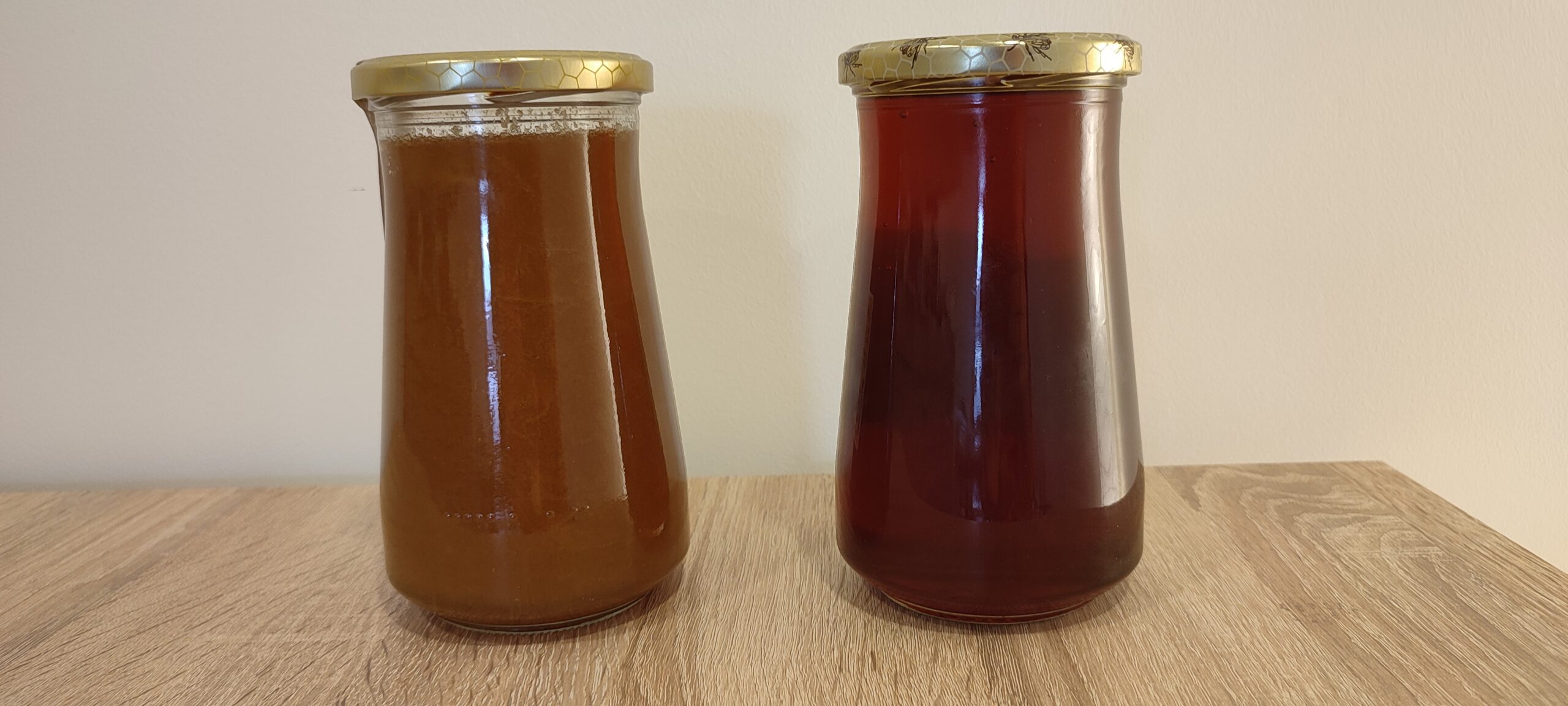
1. The Bee’s Perspective: How 6-Legged Engineers Build a 3,000-Year Time Capsule
“Bees don’t make honey for your morning bagel. They engineer a hyper-dense, zero-refrigeration survival ration so 30,000 sisters can survive sub-zero winters without a single mold spore ruining the pantry. Treat bees with respect, and they pay you rent in liquid sunshine.”
— Barnaby Thorne, Head Apiarist at bee-honey.org
To understand why honey never expires—and the exact conditions under which it can ferment—you have to look at what floral nectar actually is when a foraging worker bee sucks it out of a blossom.
Raw flower nectar is essentially watered-down sugar juice. Depending on the flower and morning humidity, fresh nectar is 60% to 80% water. If you put fresh floral nectar in a jar on your counter, wild airborne yeasts will ferment it into sour swamp water within 48 hours.
So how does Apis mellifera turn perishable flower juice into a biologically immortal substance? Through a two-stage feat of biochemical and aerodynamic engineering:
- Enzymatic Inversion (The Honey Stomach Lab): As the forager flies back to the hive, she holds the nectar in her proventriculus (honey crop) and mixes in salivary enzymes—specifically invertase and glucose oxidase. Invertase snips complex sucrose molecules into simple monosaccharides (glucose and fructose), while glucose oxidase generates gluconic acid and trace hydrogen peroxide to sterilize the nectar during processing.
- The HVAC Wing-Fanning Brigade: Back at the hive, house bees pass the droplet mouth-to-mouth (trophallaxis) to expose it to warm hive air (kept at a precise 93–95°F / 34–35°C), then spread it in thin films across hexagonal wax cells. Thousands of worker bees lock their feet onto the comb and beat their wings at 200+ beats per second in coordinated relay teams—creating a biological wind tunnel that evaporates excess water out of the hive entrance.
- The 18.6% Refractometer Seal: Bees possess humidity-sensing receptors on their antennae. They will refuse to cap a honeycomb cell until the moisture content drops below 18.6% (typically 16.5% to 18.0% in my late-summer apiary refractometer checks). Only when that exact threshold is hit do they seal the cell with an airtight lid of pure beeswax.
Considering how many bees it takes to make 1kg of honey—roughly 4 million flower visits and 110,000 miles of flight—wasting a single jar because you misunderstood a little crystallization is a crime against insect labor.
2. The Biophysics of Immortality: Water Activity (0.60 aw) & Osmotic Implosion
Honey does not expire because its water activity sits between 0.56 and 0.60 aw, well below the minimum threshold required for bacteria (0.91 aw), yeasts (0.80 aw), or molds (0.70 aw) to survive. Combined with a low acidic pH of 3.2 to 4.5, honey acts as a hyper-osmotic desert that dehydrates invading microbes instantly.
The Osmotic Implosion Vector: Why Total Moisture (%) Is Not the Whole Story
Most blogs lazily tell you “honey is low in water.” Food microbiologists look at a far more important number: Water Activity (aw), which measures how much unbound, free water is available for microorganisms to drink.
In ripened honey, almost every single H2O molecule is locked in tight hydrogen bonds with densely packed fructose and glucose molecules. When an airborne bacterium or mold spore lands on honey with a water activity of 0.58 aw, physics takes over via osmotic plasmolysis:
- Osmotic Suction (Plasmolysis): The sugar concentration outside the microbe is so extreme that water is violently pulled out of the bacterium’s cytoplasm through its cell membrane, collapsing the cell wall inward like a deflated balloon.
- The Gluconic Acid Shield (pH 3.9): Bee-secreted glucose oxidase creates gluconic acid, dropping honey’s pH to ~3.9—more acidic than tomato juice—which denatures microbial membrane proteins.
- The 0.61 aw Danger Line: Only one group of organisms on Earth sits dormant in honey waiting for a mistake: osmophilic (sugar-loving) wild yeasts like Zygosaccharomyces rouxii. They cannot reproduce below
0.60 aw(~18% moisture), but the moment honey absorbs atmospheric humidity above 19.0–20.0% moisture, they wake up and begin fermenting.
The Honey Moisture & Fermentation Risk Scale
How water percentage dictates whether a jar lasts 3,000 years or ferments in 30 days
Immortal Grade. Zero fermentation risk regardless of wild yeast count. Thick, dense, and shelf-stable for centuries.
Standard Capped Hive Grade. Safe indefinitely if kept sealed; watch for two-layer phase separation during crystallization.
Caution Zone. Often harvested too early (uncapped comb) or left open in humid rooms. Will ferment at warm room temps.
Active Fermentation Zone. Osmophilic yeasts rapidly convert sugars into ethanol and CO2 gas bubbles.
3. Visual Jar Diagnostics: White Foam, Two Layers, Black Specks & Sour Smells
Before you throw out a questionable jar of honey, match its visual and aromatic symptoms against the four distinct physical states of raw honey below. Nearly all visual changes in a honey jar are caused by harmless physics (air buoyancy or sugar crystallization) rather than microbial spoilage.
| What You See / Smell in the Jar | What It Actually Is | Safe to Eat? | Action Required |
|---|---|---|---|
| Dry white foam or creamy white ring at the top surface | Micro-air bubbles, pollen grains, and fine beeswax particles floating upward | ✅ 100% Safe (Best part!) | Eat it with a spoon! It’s packed with pollen and propolis aromatics. |
| White streaks (“frosting”) on the inside glass walls | “Frosting” / Air-gap crystallization: Glucose crystals forming around trapped air pockets | ✅ 100% Safe | Sign of ultra-low moisture (<17%). Leave as-is or gently warm to 104°F. |
| Two distinct layers: Pale solid bottom + dark runny liquid top | Phase Separation: Glucose crystallized on bottom; water & fructose rose to the top | ⚠️ Safe NOW, but stir or warm soon | Warm gently in a 104°F water bath and stir well so the high-moisture top layer doesn’t ferment. |
| Tiny dark brown or black specks suspended in the honey | Raw propolis resin flecks, dark pollen, or microscopic wax cappings from extraction | ✅ 100% Safe | Proof the honey was coarse-strained rather than industrially ultrafiltered. |
| Rising gas bubbles, bulging lid, smells like beer, wine, or sourdough | Wild Yeast Fermentation (Zygosaccharomyces converting sugar to ethanol + CO2) | ⚠️ Safe for adults (Culinary / Mead) | Safe to bake, glaze meats, or make vinaigrettes. Pasteurize at 145°F for 30 min to stop fermentation. |
| Fuzzy green, black, or gray carpet on top + putrid/rotten odor | True Surface Contamination (water or food crumbs introduced via dirty spoon) | ❌ Discard Immediately | Throw the jar away. Never double-dip a buttered or wet toast knife into honey! |
3.1 White Foam on Top of Raw Honey: Is It Safe to Eat?
Yes, white foam on top of raw honey is completely safe to eat and is actually a hallmark of unheated, unfiltered quality. This dry, marshmallow-like white collar consists of microscopic air bubbles trapped during centrifugal extraction, bound together by buoyant bee pollen grains, propolis resins, and tiny beeswax particles that slowly float to the surface over several weeks.
Because raw honey is extraordinarily viscous, tiny air bubbles take weeks to travel from the bottom of a jar to the top (governed by fluid dynamics and Stokes’ Law). In fact, here is footage from our own apiary showing just how slowly a single air bubble travels through genuine, low-moisture raw honey:
Apiary Viscosity Test: Watch how slowly trapped air rises in genuine, low-moisture raw honey. When millions of microscopic bubbles finally reach the top, they form the classic white foam ring.
How to tell harmless white air-foam from fermentation froth in 5 seconds:
- Harmless Raw Foam: Smells floral and sweet, feels dry/creamy like meringue, stays in a thin ring at the top, and the jar lid never hisses when opened. (In my house, we fight over who gets the first spoonful of the foam layer because it holds the highest concentration of bee pollen and floral aromatics!).
- Fermentation Froth: Smells noticeably sharp, boozy, yeasty, or like overripe fruit; bubbles actively regenerate from the middle of the jar; the honey underneath turns runny and thin.
3.2 Why Did My Honey Separate Into Two Layers? (The Phase Separation Trap)
Honey separates into two layers—a pale, solid crystalline layer on the bottom and a dark, runny liquid layer on top—due to fractional crystallization of glucose. As glucose molecules lock into crystals and sink to the bottom of the jar, they release the water molecules previously bound to them, pushing excess moisture upward into the liquid fructose layer.
Here is the hidden biochemical danger that catches even experienced beekeepers off guard:
Suppose your jar started at a totally safe 18.2% moisture. When half the jar crystallizes at the bottom, the solid glucose crystals only lock up about 9.1% water by weight. Where does the rest of the water go? It gets squeezed upward into the dark liquid layer on top! Suddenly, that top liquid layer spikes to 21% to 24% moisture (`>0.65 a_w`), allowing wild yeasts to start fermenting the top half of your jar even though the honey was harvested properly.
The Fix: Never leave a half-crystallized, two-layer jar sitting in a warm cupboard for months. Either stir the two phases vigorously back together, or warm the whole jar in a `104°F (40°C)` water bath until uniform.
3.3 Does Fermented Honey Smell Like Beer or Alcohol? Is It Safe to Eat?
Yes, fermented honey smells distinctly like beer, sourdough bread, cider vinegar, or dry white wine because osmophilic yeasts (Zygosaccharomyces) convert honey sugars into ethanol and carbon dioxide gas. While fermented honey has lost its fresh floral flavor, it is completely safe for healthy adults to eat or cook with as long as there is no fuzzy surface mold or putrid contamination.
In fact, fermented honey is literally the earliest form of human alcohol: wild mead. If a jar in your pantry has mildly fermented:
- Do NOT throw it away: Use it in barbecue marinades, sourdough bread dough, roasted root vegetable glazes, or whisked with olive oil and Dijon mustard for a phenomenal honey-mustard vinaigrette.
- How to halt early fermentation: Place the open jar in a water bath heated to 145°F (63°C) for 30 minutes. This pasteurizes the wild yeasts and evaporates excess moisture, stabilizing the honey for kitchen use (though it will no longer be enzymatically “raw”).
3.4 What Are the Tiny Black or Brown Specks in Raw Honey?
Tiny black, dark brown, or amber specks suspended inside raw honey are natural particles of bee propolis (tree resin), dark floral pollen, or microscopic fragments of honeycomb wax. Unlike commercial supermarket honey—which is pressure-filtered through diatomaceous earth at 150°F to look like clear plastic—authentic raw honey is only coarse-strained to preserve its bioactive compounds.
How do you distinguish natural propolis/wax specks from actual mold?
- Propolis & Wax Specks: Suspended inside the honey or resting inside the dry white foam ring; hard or waxy when rubbed between your fingers; zero fuzzy filaments; smells warm and balsamic.
- Actual Mold: Only grows on the top air-exposed surface (usually because someone dipped a wet spoon or buttered toast knife into the jar); forms fuzzy, velvety colonies (green, gray, or black) and smells musty or damp.
4. Why Does Honey Crystallize? The Glucose-to-Fructose Ratio Explained
Honey crystallizes because it is a supersaturated sugar solution containing more dissolved glucose than its tiny 17% water fraction can permanently hold in liquid form. Because glucose has lower water solubility than fructose, glucose molecules spontaneously detach from water and lock onto microscopic seed nuclei (pollen grains, wax flecks, or air bubbles) to form a solid crystal lattice.
Whether a jar of raw honey crystallizes in 10 days or stays liquid for 3 years depends almost entirely on one botanical ratio: the flower’s Fructose-to-Glucose (F/G) Ratio.
The Honey Crystallization Speed Spectrum
Why some 100% pure raw honeys solidify in weeks while others stay liquid for years
Solidifies in 1 to 4 weeks—sometimes right inside the hive frames before the beekeeper can extract it!
Crystallizes in 2 to 4 months into a smooth, creamy, fine-grained spreadable texture.
Crystallizes in 4 to 9 months. High-grade Manuka honey is naturally creamed for velvety stability.
Remains liquid for 12 to 24 months at room temperature before forming large, slow crystals.
Stays pourable for 2 to 5+ years naturally without any heating or filtration.
The 57°F (14°C) Temperature Trap: Why Winter & Refrigerators Solidify Honey
Most people assume honey crystallizes fastest at freezing temperatures. Actually, food physics shows that crystallization peaks inside a very specific temperature window: 50°F to 59°F (10°C to 15°C), with maximum crystal growth speed occurring right at 57°F (14°C).
- At 57°F (14°C) — The Danger Zone: Glucose solubility drops sharply, yet the honey is still warm enough for glucose molecules to move around and snap onto crystal nuclei. An uninsulated winter pantry or wine fridge at 57°F will turn liquid honey solid in days.
- At 68°F–75°F (20°C–24°C) — Ideal Room Storage: Glucose stays dissolved much longer, while enzyme activity remains stable.
- Below 0°F (-18°C) — Deep Freezer Arrest: Ironically, placing fresh liquid raw honey in a deep freezer makes its viscosity so glass-like that glucose molecules are frozen in place and cannot move to form crystals! (Professional honey judges actually store competition samples in sub-zero freezers to preserve freshly extracted liquid honey for years).
5. How to Decrystallize Honey Without Killing Enzymes (And Why Microwaves Create HMF)
To decrystallize honey safely without destroying its bioactive enzymes, submerge the sealed jar in a warm water bath maintained between 95°F and 104°F (35°C to 40°C) for 30 to 45 minutes, stirring every 15 minutes. Never heat raw honey above 110°F (43°C) or microwave it, as high heat denatures glucose oxidase and converts fructose into hydroxymethylfurfural (HMF).
The Forensic Chemistry Vector: Hydroxymethylfurfural (HMF) & Thermal Decay
When someone tells you “don’t microwave honey because it kills the good stuff,” they rarely explain the actual chemical reaction happening inside the jar. Beyond destroying heat-sensitive enzymes like invertase and diastase (which begin unraveling above 104°F / 40°C), overheating triggers an acid-catalyzed dehydration of fructose into an organic compound called 5-Hydroxymethylfurfural (HMF).
- Fresh Raw Hive Honey: Contains virtually 0 to 4 mg/kg of HMF.
- The International Legal Limit: Under Codex Alimentarius and EU Honey Directive standards, any honey exceeding 40 mg/kg of HMF (or 15 mg/kg for certain premium grades) is legally disqualified as heat-damaged or old.
- The Microwave Spike: A 60-second blast in a 1,000-watt microwave creates localized superheated pockets exceeding 185°F (85°C), spiking HMF levels exponentially, darkening the honey via Maillard caramelization, and destroying 90%+ of its peroxide-generating glucose oxidase.
- Lethal to Bees: Here is a wild apiary fact—never feed overheated or old dark honey back to honeybees! At concentrations above 150 mg/kg, HMF causes gut ulceration in Apis mellifera and is acutely toxic to the colony.
The Kitchen Counter Lab: The 104°F (40°C) Enzyme-Safe Decrystallization Protocol
Remember earlier when we talked about hive temperatures? Bees maintain their brood nest at 95°F (35°C), and on hot summer days the honey supers safely reach 104°F (40°C). That is your biological speed limit.
Protocol A: Decrystallizing Honey in a Glass Jar (The Gold Standard)
- Set Up a Thermal Buffer: Place a folded kitchen washcloth or silicone trivet at the bottom of a pot or large bowl so the glass jar never touches hot metal directly.
- Draw 104°F (40°C) Water: Fill the pot with warm tap water (use a kitchen thermometer, or test with your wrist—it should feel like a comfortably warm baby bath, never hot enough to steam). Water level should reach 75% up the side of the jar.
- Submerge & Stir: Loosen the lid slightly for pressure relief (keep water out!), set the jar on the cloth, and let it sit for 20 minutes.
- Break the Core: Open the jar and gently stir the softened outer honey toward the solid center core with a clean dry spoon. Refresh the warm water back to 104°F and wait another 20 minutes until crystal-clear.
Protocol B: How to Decrystallize Honey in a Plastic Bottle Without Melting or Leaching
Never put a thin PETE (#1) plastic honey bear in hot water above 115°F or in a microwave—the bottle will warp and leach microplastics/antimony. Instead:
1. Place the tightly sealed plastic squeeze bottle inside a dry Ziploc freezer bag (to protect the flip-top cap from water).
2. Submerge it in a bowl of lukewarm 98°F–102°F (37°C–39°C) tap water for 30 minutes, squeezing the sides of the bottle every 10 minutes to break up the crystal lattice.
3. Once soft enough to squeeze, transfer the honey permanently into a wide-mouth glass Mason jar so you can easily scoop it next time it crystallizes!
6. Turning “Spoiled” Into Superfood: The Synbiotic Fermentation Vector
What if your jar of raw honey picked up extra humidity, started bubbling slightly, and smells faintly tangy? Or what if you intentionally want to unlock the dormant probiotics living inside raw honey?
The Synbiotic Multiplier: Why Controlled Honey Fermentation Unlocks 3x More Gut-Healing Butyrate
Raw honey is not just glucose and fructose. Roughly 5% to 10% of authentic raw honey consists of rare, complex indigestible oligosaccharides—including panose, kojibiose, isomaltose, and erlose. Human digestive enzymes in the small intestine cannot break these down.
Instead, these bee-crafted oligosaccharides travel intact to your lower colon, where they act as precision prebiotics for beneficial Bifidobacteria and Lactobacillus strains. When you pair raw honey with live ferments (or intentionally trigger a controlled lacto-fermentation like raw honey-fermented garlic), two extraordinary things happen:
- Waking the Hive Microbiome: Crushing fresh garlic cloves into raw honey releases plant water, bumping the moisture above
20%. Dormant lactic acid bacteria (including honeybee crop strains like Apilactobacillus kunkeei) and wild yeasts wake up and pre-digest the sugars while preserving garlic’s allicin derivatives. - Colonic Butyrate Surge: In the gut, probiotic fermentation of honey oligosaccharides yields high concentrations of butyrate—the primary Short-Chain Fatty Acid fuel source for colonocytes (gut lining cells).
- Tight-Junction Sealing & Vagus Nerve Signaling: Butyrate tightens intestinal epithelial junctions (reducing gut permeability) and stimulates enteroendocrine L-cells to release GLP-1 and gut-derived serotonin precursors.
Important Safety Boundary: Whether honey is fresh, crystallized, or intentionally fermented with garlic, never give any honey product to infants under 12 months of age. Dormant Clostridium botulinum endospores unaffected by water activity or mild fermentation can colonize an infant’s underdeveloped gut microbiome.
7. The Apiarist’s Myth-Buster Vault: 4 Storage Lies That Ruin Good Honey
If you search TikTok or generic lifestyle blogs for honey storage advice, you will run into a minefield of terrible advice. Let’s put four of the biggest myths to rest permanently:
❌ Myth 1: “Crystallized honey is fake or cut with table sugar.”
The Truth: The exact opposite! Cheap corn-syrup-adulterated “honey” stays liquid on supermarket shelves for years because it contains maltose/dextrin crystal inhibitors and has had every microscopic pollen nucleus ultrafiltered out. Fast crystallization is proof of high natural glucose and intact raw pollen.
❌ Myth 2: “Store honey in the refrigerator to keep it fresh.”
The Truth: Putting honey in a 40°F–55°F refrigerator pushes it directly through the crystallization danger zone, turning it into an un-scoopable brick while dulling its volatile floral aromatics. Store honey in a dark cupboard at 65°F–75°F (18°C–24°C).
❌ Myth 3: “The ‘Best By’ date on the jar means it goes bad.”
The Truth: Food packaging regulations in the US, UK, and EU require producers to stamp a 2-to-3-year “Best Before” date for inventory rotation and HMF tracking. As long as the lid stayed tight in a cool, dark pantry, a 10-year-old jar of raw honey is completely safe.
❌ Myth 4: “You can keep honey in a wooden dipper pot with an open notch.”
The Truth: Honey is aggressively hygroscopic—it pulls water molecules straight out of the air whenever relative humidity exceeds 60%. Those cute ceramic honey pots with a notch in the lid will absorb atmospheric moisture and ferment within weeks. Use an airtight glass jar with a rubber-lined screw lid!
8. The Apiarist’s 5 Golden Rules for Eternal Honey Storage
If you want your favorite jars—whether it is a delicate spring wildflower harvest or one of the top 5 best honeys in the world—to retain their living enzymes and floral complexity for decades, follow these five rules:
- Glass Over Plastic, Always: Thin plastic bottles are slightly gas- and moisture-permeable over multi-year timelines. Store long-term reserves in airtight glass jars with plastisol-lined metal lids or clamp-top bail lids.
- Keep It Dark (UV Protection): Sunlight photodegrades glucose oxidase—the exact enzyme responsible for honey’s hydrogen peroxide activity. Keep jars inside a closed cabinet or use amber/violet glass.
- Never Double-Dip a Wet or Crumby Spoon: One microscopic drop of tap water or a sourdough toast crumb introduces both free water (
aw > 0.95) and foreign mold/yeast spores onto the top surface. - Respect the 68°F–75°F (20°C–24°C) Sweet Spot: Keep jars away from the cabinet directly above your stove, dishwasher, or oven vent, where daily heat spikes quietly drive up HMF levels.
- Want Honey That Never Crystallizes? Buy High-Fructose Varieties: If you hate dealing with solid jars, choose monofloral honeys with a natural Fructose-to-Glucose ratio above 1.45 (such as pure Black Locust / Acacia or Tupelo), or opt for naturally creamed certified UMF Manuka honey.
Frequently Asked Questions About Honey Expiration, Foam & Crystallization
Is the white foam on top of raw honey safe to eat?
Yes, 100% safe. The dry white foam or creamy collar on top of raw honey is simply microscopic air bubbles trapped during extraction alongside buoyant bee pollen, propolis, and tiny beeswax flecks that slowly rose to the surface. It is a sign of unheated, unfiltered raw honey and is often the most flavorful part of the jar.
Why did my honey separate into a solid bottom and a dark liquid top?
This is called phase separation. Glucose molecules crystallize and settle into a pale solid layer at the bottom, releasing bound water upward into the dark, fructose-rich liquid layer on top. Because that top liquid layer now has a higher moisture content (often above 20%), you should gently warm the jar in a 104°F (40°C) water bath and stir the two layers back together so the top layer doesn’t ferment.
Does fermented honey smell like beer or alcohol, and will it make me sick?
Yes, fermented honey smells fruity, yeasty, or like beer, cider, or sourdough because sugar-tolerant wild yeasts (Zygosaccharomyces) are converting sugars into trace ethanol and carbon dioxide bubbles. As long as there is no fuzzy surface mold or foul rot, fermented honey will not make healthy adults sick—it is essentially wild mead starter and is delicious in baking, marinades, and salad dressings.
How do I decrystallize honey in a plastic bottle without melting it?
Never microwave a plastic honey bottle or submerge it in boiling water. Instead, place the sealed plastic bottle inside a waterproof Ziploc bag and submerge it in a bowl of warm tap water at 98°F to 102°F (37°C to 39°C) for 30 minutes, gently squeezing the bottle every 10 minutes until the crystals soften enough to pour into a glass jar.
What are the tiny black specks in my raw honey?
Tiny black or dark brown specks suspended inside raw honey are harmless flecks of natural bee propolis (antimicrobial tree resin), dark floral bee pollen, or tiny bits of wax cappings from the hive. Unlike surface mold (which is fuzzy and grows only on top of water-contaminated honey), propolis specks are completely safe and rich in antioxidants.
Why does microwaving honey ruin it?
Microwaving creates superheated pockets above 160°F (71°C) that instantly destroy honey’s beneficial enzymes (glucose oxidase, invertase, and diastase) and dehydrate fructose into hydroxymethylfurfural (HMF), a compound used by food labs as the primary chemical marker of heat-damaged honey.