

The 30-Second Bottom Line
Yes, you can eat the entire raw honeycomb—including both the raw liquid honey and the beeswax hexagonal cells. Beeswax is non-toxic, food-safe, and approved as a natural food additive (E901). However, humans lack the specialized carboxyl ester lipase enzymes required to break down long-chain wax esters (\(C_{40} ext{–}C_{48}\)), meaning the wax passes through the digestive tract largely intact as roughage.
1. The Edible Wax Reality: You can chew raw honeycomb like natural chewing gum until the burst of liquid honey dissipates, then either swallow the remaining wax pellet or spit it out.
2. Superior Bioactive Preservation: Because comb honey is untouched by centrifugal spinning, pumping, or micro-straining, it retains 100% of the hive’s delicate volatile aromatics, royal jelly traces, and fresh propolis cappings.
3. Storage Protocol: Never refrigerate raw honeycomb. Room temperature pantry storage (\(65 ext{–}75^\circ ext{F}\)) prevents premature crystallization and preserves comb fragility.
The Bottom-Line Warning: Consuming modest portions of comb wax is completely benign. However, swallowing massive fist-sized chunks of pure wax in one sitting can cause mechanical stomach cramps or mild gastrointestinal upset due to the dense accumulation of indigestible esters.
There is no sensory experience in the culinary world quite like slicing into a fresh square of raw comb honey. When you press a spoon through the wax cappings, pure, unheated nectar floods the plate, releasing floral aromatics that have been hermetically sealed by bees since the summer bloom. Yet the first question every newcomer asks is invariably the same: Can you actually eat the wax?
For decades, supermarket shoppers have been conditioned to see honey only as a clear, amber syrup in a plastic squeeze bottle. Confronted with a raw slab of architectural beeswax, many hesitate, wondering if the wax is digestible, whether it clogs the arteries, or if it should be discarded. In this guide, we dive into the lipid biochemistry of beeswax, explain how your digestive system handles wax esters, explore the unique health benefits of hive cappings, and outline the best ways to enjoy comb honey.
What the Research Shows: The Wax Ester & Bioactive Benchmark
Peer-reviewed lipid chemistry and apiculture science clarify the digestibility and composition of natural honeycomb:
- Lipid Architecture (Tulloch 1980, Bee World / Lipids): Chemical fractioning proves beeswax is comprised of roughly 35% to 40% monoesters (primarily palmitic and cerotic acid esterified with \( ext{C}_{40} ext{–} ext{C}_{48}\) fatty alcohols), 14% hydrocarbons, and 14% free fatty acids.
- Human Digestive Limitations: Clinical gastroenterology confirms that while humans secrete pancreatic lipases for triglycerides, the human gut lacks the specific microbial enzymes required to cleave ultra-long-chain wax monoesters, meaning wax passes inertly through the GI tract as insoluble roughage.
- Cappings Bioactivity (Bogdanov 2004): Wax cappings sealed by worker bees contain concentrated layers of propolis resins, rich in antimicrobial caffeic acid phenethyl ester (CAPE) and chrysin, delivering superior antioxidant stability compared to extracted bottled honey.
1. How Bees Build Honeycomb: The Miraculous Wax Glands
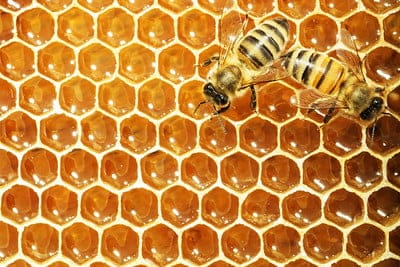
Honeycomb is not harvested from flowers—it is an organic structural wax synthesized directly by worker bees. Female worker bees (Apis mellifera) between 12 and 18 days old possess eight specialized wax glands on the underside of their abdominal sternites.
To secrete wax, bees must gorge on honey and elevate their internal body temperature to roughly \(95^\circ ext{F}\) (\(35^\circ ext{C}\)). The metabolic conversion rate is astonishing: a honeybee colony must consume approximately 6 to 8 pounds of honey to produce just 1 pound of pure beeswax. The liquid wax exudes from the abdominal glands and solidifies upon contact with the air into microscopic white scales, which the bees manipulate with their mandibles into perfect mathematical hexagons.
The hexagonal geometry maximizes structural volume while minimizing the quantity of wax required—a mathematical marvel known as the Honeycomb Conjecture, proven by Thomas Hales in 1999. To understand the physical properties of beeswax (including its melting and thermal characteristics), explore our technical guide on whether beeswax is flammable and its melting science.
2. Can You Digest Beeswax? The Human Enzyme Reality
No, the human gastrointestinal tract cannot chemically break down or absorb beeswax. When you chew and swallow a mouthful of honeycomb, your body easily absorbs the water-soluble simple sugars (fructose and glucose) into the bloodstream, but the beeswax itself passes through your digestive tract completely undigested.
Human pancreatic enzymes, primarily pancreatic lipase, are evolutionary adapted to cleave triglycerides—molecules composed of a three-carbon glycerol backbone with three fatty acid chains. Beeswax, however, consists of high-molecular-weight wax esters: single long-chain fatty acids chemically bonded to ultra-long-chain monohydric alcohols (\( ext{C}_{40} ext{–} ext{C}_{48}\)).
The Biological Comparison:
While humans lack the enzymes to digest wax esters, certain specialized species—such as the African Honeyguide bird (Indicator indicator) and the larvae of the Greater Wax Moth (Galleria mellonella)—harbor specialized intestinal gut bacteria capable of hydrolyzing wax esters into usable metabolic energy. In the human bowel, beeswax simply acts as non-fermentable insoluble fiber.
Because beeswax is biologically inert, food-grade, and non-allergenic, swallowing moderate amounts is completely safe. It does not line your stomach walls, does not enter the bloodstream, and will not elevate your cholesterol.
3. Unique Health Benefits of Eating Comb Honey vs Extracted Honey
Honeycomb is the purest, least adulterated form of honey in existence. When beekeepers bottle extracted liquid honey, the combs must be uncapped, spun in a centrifugal metal extractor at high speeds, pumped through hoses, and strained. Even minimal mechanical handling exposes liquid honey to oxygen, accelerating the evaporation of volatile floral esters.
Consuming honey in the intact comb offers several distinct bioactive advantages:
Fresh Propolis Cappings
When bees seal ripe honey cells, they blend beeswax with tree resins known as propolis. Chewing comb cappings delivers direct micro-doses of antibacterial polyphenols directly to oral tissues. Learn more about its medicinal properties in our bee propolis benefits guide.
Complete Floral Volatiles
Because the cell has remained hermetically sealed since the moment the bees capped it, the comb retains 100% of the floral terpene esters that give raw honey its complex sensory profile, which are often lost during centrifugal extraction.
Natural Chewing Satiety
Chewing honeycomb forces slow, deliberate mastication. Unlike gulping liquid sweeteners, the gradual release of honey bound within wax cells triggers oral amylase release and blunts rapid spikes in blood glucose.
4. Master Comparison: Raw Honeycomb vs Extracted Raw Honey vs Processed Honey
Here is how honeycomb measures against bottled honey formats in processing, bioactivity, and culinary application:
| Feature | Raw Honeycomb (Cut Comb) | Bottled Raw Liquid Honey | Commercial Processed Honey |
|---|---|---|---|
| Thermal History | Zero heat (\(85 ext{–}95^\circ ext{F}\) hive ambient) | Unheated or warm pumped (\(<110^\circ ext{F}\)) | Flash-pasteurized (\(>160^\circ ext{F}\)) |
| Beeswax Content | 100% Intact Comb Structure | Trace micro-particulates only | 0% (Stripped by filtration) |
| Pollen & Propolis | Maximum natural concentration | Retained via coarse straining | Stripped via diatomaceous earth |
| Crystallization Speed | Extremely slow (No seed agitation) | Moderate to fast (Normal raw state) | Never crystallizes (Dead syrup) |
| Culinary Experience | Textural, chewy, charcuterie pairing | Pourable sweetener, tea, baking | Commodity bulk syrup |
5. How to Eat Raw Honeycomb: 4 Gourmet Ways
If you have purchased a square slab of honeycomb, do not try to squeeze it through a sieve. Enjoy the comb in its whole, unprocessed glory using these four culinary pairings:
- Straight with a Spoon (The Apiary Chewing Gum): Cut a small 1-inch cube. Chew it thoroughly like a piece of natural chewing gum. As you masticate, the liquid honey floods your palate. When only the waxy ball remains, you can swallow it as gentle roughage or discard it.
- The Charcuterie Centerpiece: Place the whole honeycomb square in the center of a cheese board. Pair a sliver of comb with sharp aged cheddar, salty Manchego, creamy blue cheese, or goat cheese. The rich wax and floral sweetness cut through high-fat dairy perfectly.
- Melted over Warm Sourdough or Pancakes: Place a thin slice of honeycomb on top of piping hot toasted sourdough or fresh waffles. The ambient heat softens the beeswax to a pliable, spreadable consistency, blending seamlessly with melted butter.
- Greek Yogurt & Walnut Bowl: Drop chunks of honeycomb into thick, unflavored whole-milk Greek yogurt topped with toasted walnuts. The contrasting crunches of walnut shell and soft wax make a decadent whole-food breakfast.
6. The Myth-Buster Vault: Honeycomb Lore Debunked
Myth: “Swallowing beeswax will cause intestinal blockage and appendicitis.”
The Gastroenterology Reality: Beeswax softens significantly at body temperature (\(98.6^\circ ext{F} / 37^\circ ext{C}\)). The amount of wax in a standard 1-to-2 tablespoon serving of honeycomb is minute (typically under 1 gram). It mixes harmlessly with other dietary chyme and passes naturally without forming obstructions.
Myth: “You must keep honeycomb in the refrigerator to keep it fresh.”
The Storage Reality: Never refrigerate honeycomb! Temperatures between \(50 ext{–}57^\circ ext{F}\) dramatically accelerate glucose crystallization, turning the liquid cells gritty and solid. Furthermore, refrigeration makes the wax walls brittle. Keep honeycomb sealed in an airtight container at room temperature in a dark pantry. Learn more in our guide on refrigerating raw honey after opening.
Myth: “Commercial honeycombs are manufactured out of petroleum paraffin wax.”
The Apiary Reality: Cut comb honey sold in markets must be 100% bee-constructed. While some beekeepers use thin beeswax foundation sheets to guide comb building, reputable cut-comb honey is drawn exclusively as natural “foundationless” comb or uses food-grade virgin beeswax foundation. It is never made of petroleum paraffin.
7. The Honeycomb Safety and Storage Protocol
To keep your raw honeycomb pristine for months or years, adhere to these simple apiculture guidelines:
- Keep It in an Airtight Container: Honey is hygroscopic, meaning exposed liquid honey will draw moisture from humid kitchen air. If moisture creeps above 18.6%, wild yeasts will ferment the comb.
- Store Between \(65^\circ ext{F}\) and \(75^\circ ext{F}\): Ambient pantry temperature prevents crystallization while keeping the wax structurally sound.
- Long-Term Freezing is Safe: If you buy comb honey in bulk during the summer harvest, you can freeze uncut comb indefinitely. Freezing halts all enzymatic aging and crystal growth without cracking the wax cells.
- The Infant Safety Rule: Just like liquid raw honey, honeycomb must never be given to infants under one year old due to the risk of infant botulism spores, as covered in our raw honey safety guide.
Scientific Sources & References
- Tulloch, A. P. (1980): “Beeswax—composition and analysis.” Bee World, 61(2), pp. 47–62. Comprehensive chemical characterization of monoesters, diesters, and hydrocarbons.
- Bogdanov, S. (2004): “Beeswax: Quality issues today.” Bee World, 85(3), pp. 46–50. Lipid composition and propolis interaction in comb cappings.
- European Food Safety Authority (EFSA) (2007): “Scientific Opinion on the safety of beeswax (E 901) as a food additive.” EFSA Journal, 5(11), 615. Confirming biological safety, non-toxicity, and non-absorption of wax esters.
- Crane, E. (1990): Bees and Beekeeping: Science, Practice and World Resources. Heinemann Newnes, Oxford. Chapters on comb construction and wax secretion energetics.
- Hales, T. C. (2001): “The Honeycomb Conjecture.” Discrete & Computational Geometry, 25(1), pp. 1–22. Mathematical proof of optimal perimeter in hexagonal honeycomb structures.
Last updated: 2026-11-04

About the Author: Barnaby Thorne
Barnaby Thorne is the editorial pen name of the Bee-Honey.org research and beekeeping collective. Our team of apiary specialists and food scientists is passionate about sustainable beekeeping, hive products, and making complex biochemistry accessible and actionable for everyday consumers.