
The 30-Second Bottom Line
What does it mean when a bee lands on you? Biologically, a bee lands on your skin for one of four harmless reasons: harvesting sweat salt (sodium and potassium electrolytes), absorbing conductive body warmth (recovering from chill torpor below 55°F), investigating floral perfume esters, or simply resting exhausted wings after miles of foraging.
Will she sting? NO. Solitary foraging bees away from their hive have zero defensive aggression. Stinging a human tears away the worker’s barbed stinger, causing her instant death.
The Golden Rule: Never swat or blow your breath on the bee. Human exhaled breath contains concentrated carbon dioxide ($CO_2$), which honey bees are genetically wired to interpret as a predator attack signal (like a bear breathing into a hive). Remain still, let her sip trace minerals, and she will fly away peacefully within 60 to 90 seconds.
Quick-Reference Guide: Why Bees Land on Humans & How to Respond
| Bee Behavior / Situation | Primary Biological Cause | Observable Physical Sign | Sting Risk | Correct Immediate Action | Folklore / Symbolism |
|---|---|---|---|---|---|
| Licking Skin Gently | Harvesting Sweat Salts & Minerals | Straw-like proboscis extending across skin | 0% (Zero Threat) | Stay still; let her drink for 30–60 seconds | Good luck, physical vitality, reward for hard labor |
| Sitting Motionless on Arm | Absorbing Body Heat (Chill Torpor) | Wings folded; motionless in cool weather (<55°F) | 0% (Muscles too cold to sting) | Cup your hand over her to radiate gentle warmth | Patience, endurance, seeking sanctuary |
| Crawling Rapidly on Clothes | Floral Scent or UV Color Confusion | Antennae tapping bright yellow, purple, or floral print | Very Low (<1%) | Gently brush away with a leaf or paper card | Creativity, fertility, sweet abundance arriving |
| Grooming Antennae / Wings | Exhaustion Rest & Pollen Cleansing | Front legs stroking head; loaded pollen baskets | 0% (Preoccupied) | Observe the golden pollen corbiculae on her hind legs | Message to pause, rest, and celebrate accomplishments |
| Buzzing Loudly & Bumping Skin | Defensive Hive Warning (Head-Butting) | High-pitched angry pitch; repeated collision without landing | High (Near Colony) | Walk calmly 50 feet away; you are near a nest | Boundary warning; respect sacred ground |
Entomological Field Science & Mineral Foraging: Behavioral research on Apis mellifera (Bonoan et al. 2017; Lau & Nieh 2016) demonstrates that worker bees actively seek out supplementary electrolytes, particularly sodium ($Na^+$) and potassium ($K^+$), which are scarce in floral nectar but essential for colony flight muscle physiology and brood rearing. When an ambient forager lands on human skin, it unrolls its proboscis to lap up dilute perspiration salts. Field entomologists and beekeepers note that mineral-foraging bees are entirely non-defensive, stinging only if mechanically pinched or crushed against clothing.
You are sitting quietly on a sunny garden bench, enjoying a summer breeze, when suddenly a soft, velvety weight touches down on your bare forearm. You look down, and there she is: an amber-banded honey bee, gently resting her delicate translucent wings and rhythmically pulsing her antennae across your skin.
For many people, this moment triggers an instantaneous spike of primal panic. Heart rate doubles, muscles clench, and the reflexive instinct is to violently fling your arm or swat the intruder into oblivion.
As any experienced beekeeper, naturalist, or apiary specialist will tell you: a bee on your skin is one of the gentlest encounters in the natural world.
That tiny insect didn’t land on you because she is angry, aggressive, or plotting to hurt you. To her, you are a mountain of comforting warmth, an intriguing scent puzzle, or a vital mineral watering hole in the middle of a long foraging journey.
In this 2026 definitive guide, we unpack the fascinating sensory biology behind why bees land on humans, explain why honey bees dread stinging you, debunk the predator $CO_2$ breath trigger, explore ancient cultural folklore, and teach you the gentle Sugar-Water Revival Protocol for exhausted bees.
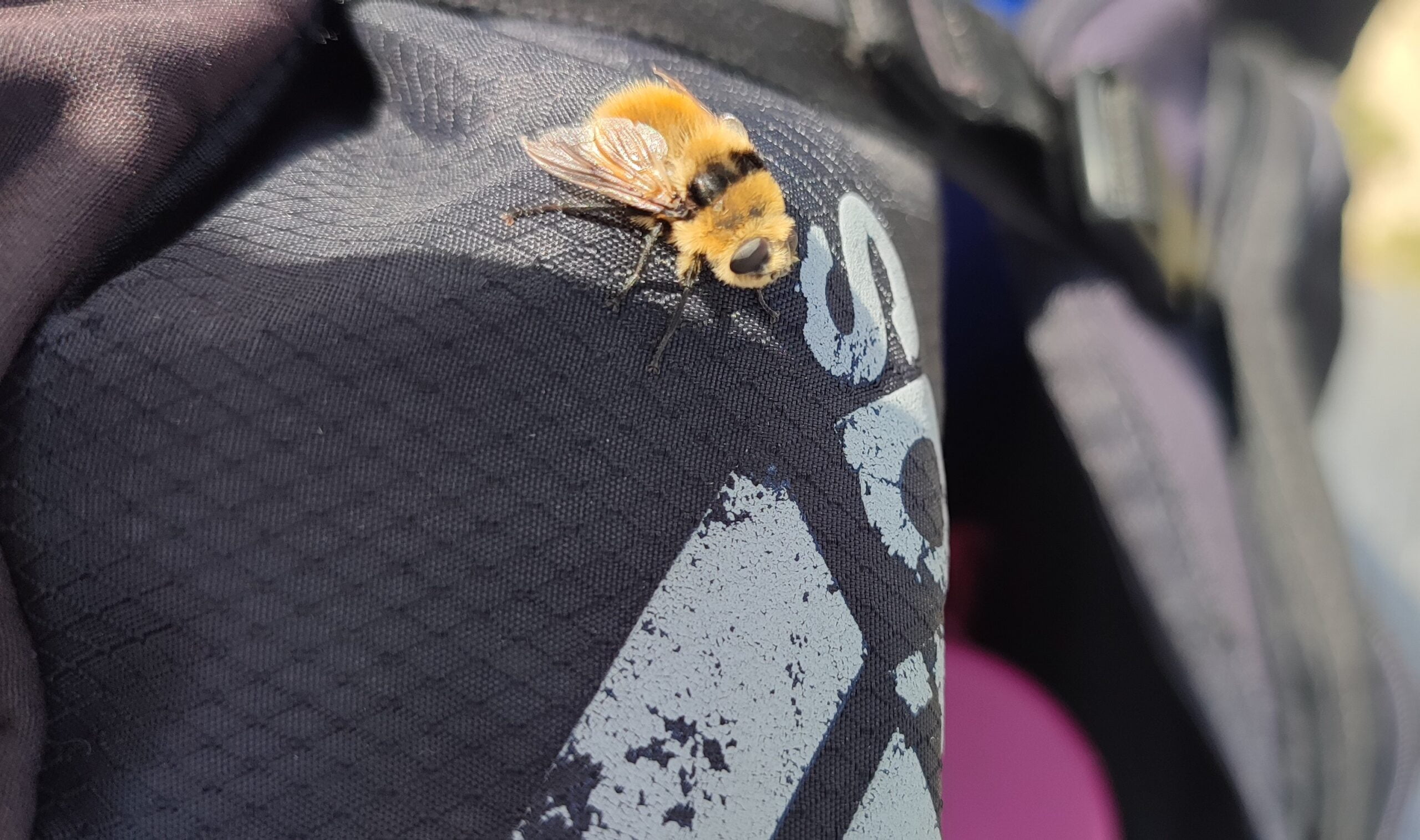
1. The Science: The 4 Biological Reasons a Bee Chooses Your Skin
The Core Sensory Principle: Honey bees possess over 170 distinct olfactory receptors on their antennae and five compound/ocelli eyes tuned to ultraviolet light. When a bee lands on you, she is responding to complex biochemical and thermal stimuli.
Mineral Hunger: Drinking Sweat Salts
Floral nectar provides ample carbohydrates (glucose and fructose), but is almost completely devoid of sodium, potassium, and magnesium. Developing honey bee larvae require these electrolytes for nervous system formation. Human sweat contains approximately 0.9 grams of sodium chloride per liter. To an apiary forager, your arm is a gourmet electrolyte bar.
Thermal Recharging: Beating Cold Torpor
A honey bee’s thoracic flight muscles must remain above 95°F (35°C) to sustain aerodynamic lift. If a passing cloud or cool autumn wind drops ambient air below 55°F (13°C), the bee experiences “cold torpor”—her wings lock up and she drops. Landing on your 98.6°F (37°C) forearm transfers conductive body heat directly into her flight motor.
Scent & Ultraviolet Camouflage
Botanical body lotions, citrus shampoos, lavender perfumes, or sunscreens containing natural floral esters mimic the pheromone signatures of rich nectar sources. Furthermore, bees see the world in ultraviolet; bright clothing (especially blues, violets, and yellows) reflects UV light in patterns resembling meadow blossoms.
Exhaustion & Wing Fatigue
During her short 6-week summer lifespan, a foraging bee flies up to 500 miles. When carrying heavy pollen corbiculae in gusty headwinds, her flight tank runs dry. She lands on you simply to catch her breath, groom dust from her compound eyes, and rest before making the final flight home.
2. The 4-Step Field Protocol: What to Do When a Bee Lands on You
If a bee lands on your hand, arm, or shirt, follow this exact sequence to ensure both you and the bee walk away unharmed:
Freeze and Suppress the Swat Reflex
Sudden kinetic motion triggers a defensive reflex. Keep your arm relaxed and steady. The bee cannot sting unless pressed against skin or trapped inside clothing folds.
Control Your Breath (Do NOT Blow on Her)
The internet often advises “gently blow her away.” This is dangerous advice. Honey bees have evolved specialized antennae sensors that detect warm carbon dioxide ($CO_2$) plumes. In nature, warm $CO_2$ means a predatory bear or skunk is attacking the hive. Blowing on a bee transforms a peaceful visit into a defensive alarm state.
Inspect Her Proboscis Licking
Take a close look. You will almost certainly see her delicate tongue licking invisible sweat salts from your pores. She will typically drink for 30 to 90 seconds, groom her antennae, and buzz away on her own.
Use a Leaf or Paper Card for Gentle Transfer
If you must move or if the bee is in an awkward spot, slide a stiff piece of paper or a green leaf gently under her front feet. She will naturally climb upward onto the leaf, allowing you to deposit her onto a nearby flower.
3. The Cultural Folklore: What Ancient Traditions Believed
Long before modern entomologists analyzed sweat salts and ultraviolet photoreceptors, human civilizations across five millennia treated a bee landing on someone as an auspicious spiritual omen:
- Ancient Greece & Rome: The sacred bee was connected to Apollo and the Delphic Muses. A bee landing on an orator or poet (such as Plato or Virgil) was believed to bestow the “gift of the golden tongue”—speech dripping with sweet wisdom and eloquence.
- Celtic Mythology: In ancient Ireland and Scotland, bees were reverently called “messengers between the worlds.” A bee visiting your home or landing on your shoulder meant that ancestral spirits were watching over you, or that good news was traveling from afar.
- Universal Folklore: Across European pastoral lore, a bee landing on your hand without stinging was an infallible omen of unexpected financial good fortune, fertility, and reward for industrious labor.

About the Author: Barnaby Thorne
Editorial Pen Name & Apiary Contributor Team
Barnaby Thorne is the collective pen name of the Bee-Honey.org editorial and apiculture team. Our team shares practical apiary observation and peer-reviewed insect behavioral science to help nature lovers and gardeners interact calmly and safely with pollinators. “Calmness is contagious. When you quiet your heart, the bee feels only peace.”
📚 Scientific Sources & Insect Behavior References
- Bonoan, R. E., et al. (2017). Seasonal variation in honeybee foraging for water and minerals. Apidologie, 48(5), 643–652.
- Lau, P. W., & Nieh, J. C. (2016). Salt preference in the honey bee (Apis mellifera). Journal of Experimental Biology, 219(24), 3894–3899.
- Seeley, T. D. (1995). The Wisdom of the Hive: The Social Regulation of Honey Bee Colonies. Harvard University Press.
- Winston, M. L. (1987). The Biology of the Honey Bee. Harvard University Press.
- Breed, M. D., et al. (2004). Defense of the honeybee colony: triggers, receptors, and behavioral response. Journal of Insect Behavior, 17(5), 651–668.
Frequently Asked Questions About Bees Landing on You
Why did a bee land on me and won’t leave?
If a bee lingers on your skin for several minutes without flying away, she is almost certainly either drinking sweat salts (which takes time) or she is exhausted and suffering from cold torpor. Her thoracic muscles lack the glycogen or temperature needed for lift. You can help by moving into direct sunlight or offering a single drop of 1:1 sugar water on a spoon.
Does a bee landing on you mean good luck?
In cultural folklore across Greek, Roman, and Celtic traditions, a bee landing on you is universally considered an omen of good luck, impending prosperity, and harmony. Biologically, it confirms that your garden ecosystem is thriving with pollinators.
Why did a bee land on me but not sting?
Honey bees only sting when their hive is threatened or when they are physically crushed against skin. Solitary foraging bees away from the hive have no interest in stinging, as deploying their barbed stinger tears their abdomen and causes instant death. A bee on your skin is merely seeking salt, warmth, or rest.
Why should you never blow on a bee?
Human breath contains concentrated carbon dioxide ($CO_2$). Honey bees possess antennal sensilla that detect $CO_2$ as a predatory threat marker (such as a bear, skunk, or badger breathing into a hive). Blowing on a bee triggers alarm pheromones and defensive behavior.
What should you do if a bee lands on your face?
Close your eyes gently, keep your mouth closed, and breathe slowly through your nose. Do not swat or shake your head. The bee will inspect your eyelashes or skin for 15 to 30 seconds and fly away. If uncomfortable, gently brush her off with a piece of paper or leaf.